
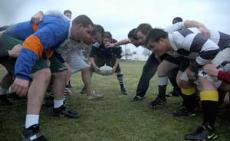
Into the scrum
the ball and wearing down the opponent.
Walter Cespedes, head coach of the Aggie rugby squad, said the scrum is an aspect of the game that requires teamwork, good technique and careful practice.
“We have to do it again and again and again until they know each other,” Cespedes said.
At first glance, a scrum looks like a confusing huddle of men pushing each other around and all of a sudden they break and start running, but it’s much more involved than that.
A scrum is formed after an illegal forward pass during play. The forwards from the two teams meet together and form a scrum to try to a possession of the ball and to put the ball back in play.
“Our job is to fight for the ball and win the ball,” Cespedes said.
A scrum is made up of two lines of forwards. On the first line are two props. These are generally big, thick guys because they are primarily responsible for pushing the scrum forward. The two props grab each other’s shirts and pull themselves close together. The other player on the first line is the hooker. The hooker is situated between them with his arms wrapped around their backs, grabbing their shirts.
On the second line are two locks. The locks are generally the tallest members of the team. This is to aid them in another part of the game called a line out. The locks reach between the legs of the props and hold the bottom of the props’ shirts with one hand as the other hand is used to tightly pull the two locks together by their shorts.
On either end of the locks is a flanker. The flankers support the locks with their shoulders so the scrum doesn’t collapse on itself. The flankers are on the outside of the scrum so they can break free quickly if the opposing team gets possession of the ball during the scrum. Behind the two locks is the number 8 position. This player moves with the scrum waiting for the ball to emerge through the back of the scrum.
The first step to a scrum is for all eight players to get in their positions described above. The forwards all crouch low. Once the referee says, “Engage,” the props and hooker of each team lock heads with the opposing team, forming a giant huddle.
Since the scrum is for a penalty, the non-offending team gets to put the ball back in play by means of a player called a scrum half. This is an advantage for that team, because the scrum half has special calls to alert his team when he will throw the ball in, Cespedes said.
The scrum half, who stands outside the scrum, yells, “Attention!” and all players in the scrum lower their hips. The scrum half then yells, “Go!” and rolls the ball ‘hamburger’ style into the middle of the scrum. The scrum half then runs to the back of the scrum waiting for the ball to clear the scrum.
This is where the fun starts. Both sides of the scrum push forward trying to jockey for position so their hooker can move the ball backward. The hooker’s job is to kick the ball backward through his team’s side of the scrum so they can get possession of the ball. The hooker has to fight because the scrum is constantly moving and the hooker on the opposing team is trying to get the ball on his side. The scrum continues to move forward step by step until the ball has cleared the scrum.
Once the ball has cleared the scrum, the number 8 or scrum half picks up the ball and yells, “Balls away!” He then throws it backward to the fly half and the scrum is over. The ball is back in play and the players get back to tackling each other.
-sethhawkins@cc.usu.edu