
In the business of filtering films
It started in the late 1990s when Ray Lines of Utah agreed to remove some questionable scenes from the movie “Titanic” for some friends. This simple act grew into the company CleanFlicks with locations across the country and a mail service set up much like the popular NetFlicks, where members are able to order movies online and have them delivered to their home.
According to the company Web site, www.cleanflicks.com, viewers don’t have to worry about viewing scenes containing profanity, nudity, graphic violence and sexual content in the films they rent because all such material is edited out. The removal of questionable material is great for viewers like James Higham, who said he likes not having to worry about what might come on during the movie.
Kasi Anderson, a sophomore majoring in dietetics, agreed.
“There are some movies that are good, they have a good storyline, a good point, but I don’t like all the violence and stuff, so edited is nice,” Anderson said.
But not everyone sees edited movies that way. According to “Bleep! Censoring Hollywood,” AMC’s documentary on the conflict, which aired in 2005, the Directors Guild of America, whose members include over 1,000 contemporary film, TV and radio directors, filed a lawsuit against CleanFlicks and other movie-editing companies in 2002 claiming that CleanFlicks and others like it – companies that edit movies without the distributors or creative artists’ consent – were violating copyright laws.
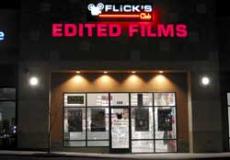
CleanFlicks and its co-defendants claimed that under the fair use law, their editing of a movie’s content is permissible. A legal battle ensued until April 2005 when President Bush signed the Family Entertainment and Copyright Act into law, which allows CleanFlicks and similar companies such as Flick’s Club, located at 1451 North 200 E., Ste. 150 in Logan, to continue editing movies for content.
For some people, the legality of Flick’s Club editing for content isn’t necessarily the biggest problem they have with the edited films industry.
“I don’t think it is right to change someone’s work. It is like you are changing the smile on the Mona Lisa. When you alter a video, you are doing the same thing – you are changing what the artist wanted to show,” Utah State University graduate Dannelle Butler said. “When a church or an organization says, ‘Do not watch rated-R shows,’ they are talking about the moral principle, not the actual scenes depicted in the movie, so it doesn’t matter whether the movie is edited or not, rated-R is rated-R.”
Butler said that if people don’t like to watch objectionable scenes found in videos that are edited, then they are sending the wrong message to Hollywood by buying edited movies or renting them.
“Hollywood doesn’t know the difference, they just know that the video is doing well. So they keep thinking that people must like that sort of material or at least don’t object to it so they keep making movies with the kind of material that people wanted edited out,” Butler said.
Tagg Archibald, a senior majoring in history education, said he rented the movie “Glory” from Flick’s Club to show some students that he was teaching.
“But for anything besides teaching, I’d go to RedBox or somewhere else. That stuff, violence, swearing, etc, just doesn’t bother me. Plus, if I’m not going to see a movie, I’m not going to see it regardless of what is in the movie,” Archibald said.
James Higham, a junior majoring in business information systems and Spanish, said he likes going to Flick’s because, “There are lots of movies that are good to see, but that have things in them I prefer not to see.”
-nealsnow@cc.usu.edu