
Parasites biting back and killing honeybees
Beekeepers in Utah are feeling the stinging effects of the varroa mite, a parasite that weakens honeybees and can kill entire hives within two to three years.
Rosalind James is the supervisory research etymologist at the USDA Bee Biology and Systematics Laboratory at Utah State University. She said the mite is significantly depleting hive populations nationwide.
“If you’ve got bees, you’ve got varroa mites,” said Sid Ellerman, a member of the Busy Bee Beekeepers club of Logan, Utah.
The mite was plaguing another species of honeybee in Asia, James said, before it was accidentally brought to the United States in the 1980s.
“We knew it existed and we were concerned about it,” said Robert Newswander of Newswander Brothers Honey Farm in Preston, Idaho.
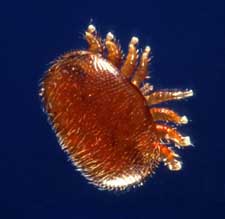
The varroa mite attaches itself to adult bees, transmitting a virus that weakens the insects. The mite uses the adult bees to get around the hive as well as to “suck juices out of adults,” James said.
The reddish-colored mites can only reproduce in the cells of the hive where broods – developing bees – are forming, James said. Because the mite fastens itself and its offspring to the larvae, when the bee develops, it has a deformed wing virus which causes its wings to crumple, she said.
After a couple of years, the number of weak and deformed bees can cause the whole hive to die, James said.
James compared the size of the varroa mite on an adult bee to a human having a tick the size of a squirrel attached to them.
Newswander, who has been in the bee business for more than 30 years, said efforts to eliminate the varroa mite by using pesticides worked for the first few years of its presence, but the mite has since become resistant to the chemicals. He said no pesticides currently approved by the USDA successfully kill the mite.
“We’re trying to develop a biological product that will control the mites,” James said.
James has been conducting research for the past seven years and has discovered a fungus which is a pathogen on the mites and not on the bees, she said. The fungus worked really well to control mite populations in lab tests, she said.
In collaboration with Cox Honey of Logan, James conducted field tests by applying spores from the fungus to beehives, which served to increase winter bee survival among hives. In additional field tests, however, the results haven’t been as successful.
James said the spores don’t survive well enough in the hive and improvements need to be made to the way spores are handled in the manufacturing process.
Due to the increase in varroa mites, being a bee keeper has become more expensive and now requires more expertise than it used to, James said.
The most noticeable effect has been in agricultural crops that need bees for pollination.
The price of renting honeybees for pollinating crops has increased three-fold over the past four years, James said.
Newswander said his approximately 5,000 colonies of bees are currently in California pollinating almonds. He said he knows a beekeeper in Burley, Idaho, whose bee population went from 6,000 colonies to 1,200 due to the varroa mite.
James said that while she researches the varroa mite’s effects on honeybees, her primary research is done on the “chalkbrood” disease that affects leaf-cutter bees.
mof@cc.usu.edu