
THEATER REVIEW: Smiling at some summer ‘Night Music’
Clear-cut black and white are colors that never really looked good on stage.
Oftentimes it can be difficult to convince yourself fully how you felt about a particular entertainment, and Utah State Theatre’s production of Stephen Sondheim’s “A Little Night Music” was just one of those instances.
Fortunately, there is a handy-dandy way to come to a compromise in your mind about how you enjoyed a particular production: Read what others have written and respond.
In one review which appeared during the original Broadway production some 31 years ago, the critic explained that “A Little Night Music” “remains too literary and precious a work to stir the emotions.”
My, how far we’ve come.
Far from lollygagging in the doldrums of feeling, while watching the musical, my emotions, while not quite agitated at gale force levels, nevertheless were stirred enough to help me question my own ideals of love, passion and happiness. It was quite refreshing, to say the least.
The plot, convoluted as any day-time soap, was nevertheless almost believable (no play can be entirely trusted), lying somewhere between far-fetched lunacy and close-knit seriousness. The lust and sexual drive which on the surface seemed to consume many of the characters sank to insignificance when the “everyman” search for real love and understanding became apparent.
The music – a tribute to the genius of Sondheim – was almost always in a somewhat minor key which lent a somewhat somber note to the actions of the players as they switched partners back and forth until they finally arrived at the place they were, seemingly, always meant to be.
The members of the cast sang at varying abilities, ranging from very good to superb, the latter personified through Monique Poyfair’s performance of “Send in the Clowns” – a true highlight of the evening. The duet by Harry Heap (Count Malcom) and Jon McBride (Fredrik) was rather sonorous and the entire cast seemed to capture part of Sondheim’s spirit in their performance of “A Weekend in the Country.”
One quip and quibble I had with the evening, however, was the technical problems associated with the microphones. The beauty of the music and the wit of the dialogue were often marred by the in and out happenstance of the rather fickle piece of technology. Imagine the frustration you would feel if Hamlet’s soliloquy went something like this: “To be … to be … whether … in the mind … suffer … slings … to dream … there’s the rub … what dreams …” and so on, and you might understand the slight frustrations associated with the performance.
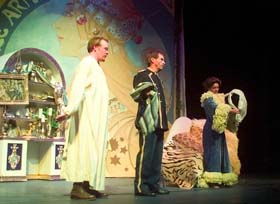
The costumes were beautiful, and the set was appropriate to the play. The rotating stage was a good touch, though some of its starts and stops could have been performed with higher accuracy. Also, while they did a marginally good job of covering it up (with duets and dialogue), the set changes were somewhat distracting from the overall quality of the production. Not wishing to appear too negative, I do understand that the distraction was somewhat unavoidable because various props were the size of semi-trucks.
Overall, I was extremely pleased with UST’s decision to run this comparatively unknown musical in lieu of some more well-known plays. It helps me believe that UST is continuing to look out for the benefit of its patrons while still remaining culturally aware. Bravo!
Every college student should see this musical, if for no other reasons than that it centers around the single most important aspect of anybody’s life: people and relationships.
In a tale filled with immorality, the moral seems to be that with regards to love, you should just get it right the first time and then stick with what you’ve chosen. It seemed that the idea of fidelity was re-enforced through the negative consequences of the infidelity of the players.
At the end of the play, just as Madame Armfeldt suggested, the audience smiles, along with the night, at the foolishness of the people we see and the foolishness within ourselves – also, just as in the play, that smile is “especially broad.”
Funny and charming, this play is delightful.
Oh yeah, I don’t think it will fail to “stir the emotions” either.
Matt Wright is a junior majoring in English literature. Comments can be sent to mattgo@cc.usu.edu.