
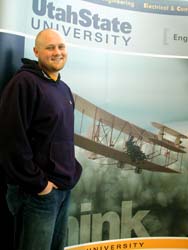
Student of the Year: One High Flyin’ Engineer
Nicholas Alley knows he loves to design things, especially airplanes, but he can’t explain exactly where that drive comes from.
“I can’t tell you why we engineers create things,” Alley said. “I think the biggest reason is nobody told us we couldn’t.”
Alley has been selected as the 2004 Utah Statesman Student of the Year. He is currently working on a doctoral degree in mechanical engineering and is best known on campus for his work with the Wright Flyer project. The project began in August 2001 when he was put in charge of supervising the 10 engineering students who designed the plane. After he lost his design team a year into the project Alley continued, supervising the building of the plane and carrying the project through to its completion.
“Without him the Wright Flyer would not have been successful,” said Warren Phillips, a professor in the mechanical and aeronautics engineering department.
But Alley refuses to take credit for the success of the plane, and said he feels the 10 engineering students, most of whom have now graduated, were not given credit they deserved. Alley said the team worked more than 20 hours a week for nine months with no appreciation, simply because it was a project they believed in.
“That’s why I feel so bad now, because I’ve gotten a lot of credit for what has happened,” Alley said. “They got one credit for this project – they did it purely because they believed in it and wanted to see it succeed, and it’s because of them they did.
“I was simply their adviser, their teacher.”
But his job was not easy and when most of the members of the design team left, Alley carried on a majority of the work mostly alone.
“To tell you the truth it was two years of hell. It was terrible,” he said. “I lost my design team a year after the project started and I had to finish through with the building and design changes that had to occur – the pressure was terrible. I’m glad it’s been so good for the university but I would never do it again. It pushed my graduation back a year.”
Still, Alley said the project was worth the hard work and he is incredibly grateful and proud to have been a part of the project. One of the biggest rewards, he said, was the opportunity to work with the flight technology department and experience first hand the “symbiotic relationship” technicians and engineers have to develop.
“I don’t regret doing it,” he said. “It was an amazing managerial experience, an amazing engineering experience. I got to shake the President’s [George W. Bush’s] hand; I got to be on the History Channel, but the highlight of it all was flying it.”
The plane took its first successful flight in March 2003 and Alley was allowed to be a passenger in one of the plane’s first flights.
“I love airplanes so I think taking a flight in an airplane that I designed was the highlight of the project,” Alley said. “It went from a small project to something that has gotten a lot of people excited about Utah State and about aviation.”
Alley said one of the most difficult things about the project was redesigning the original Wright plane into something completely different without losing the spirit of the original.
“Even though it looks like a Wright flyer, it was completely redesigned and there is really nothing about the plane except its aesthetics, its essence, that is from the Wright brothers,” Alley said. “It was extremely complicated and they did a phenomenal job.”
Another obstacle in the process was simply getting the design team familiar with planes and the unique engineering features that go along with them.
“These 10 students that designed the plane, some of them had never even been in an airplane before, and they had to be taught from the ground up,” Alley said.
Phillips said Alley is the kind of student who loves what he does, and the passion he has for his work is evident in the results he produces.
“He’s probably the most improved student I’ve seen in 32 years of teaching. He works really hard and he’s come a long, long way,” said Phillips who has advised Alley for the majority of his education.
Alley has received both his undergraduate and master’s degrees from USU in mechanical engineering. While Alley acknowledges the engineering program at USU may not have the most money or best facilities, he said the education and faculty here are superior and USU engineering is highly underrated.
“I’ve personally dealt with students from MIT, BYU and the U, and while I’m not the smartest guy in the world, I’ve learned a lot more than they have. He said he thinks we’re kind of hidden treasure. I’m very satisfied with the education I’ve gotten here,” he said. “What university did what we did?”
While Alley will one day work in industry, he plans to work with unmanned aerial vehicles. He said he eventually hopes to return to teach in a university, a door that was opened for him through the Wright Flyer project.
“I always had a goal to get my master’s. I taught an aerodynamics class that year and really enjoyed it. It was hard work but I really enjoyed teaching them. Seeing them as their knowledge increased and as they figured things out and just designed an incredible airplane,” he said. “Nobody understands how amazing what they did was. I cannot express how amazing what they did was and that made me so proud because I was their teacher. I was so proud and felt the reward of teaching.”
After the Wright Flyer project, Alley was offered a chance to work under Phillips, an opportunity Alley said “was too good to pass up.” Alley said he will graduate in 2005.
When Alley isn’t being an engineer, he said he loves to water ski in the “nooks and crannies” of Logan and watch Aggie basketball. Alley, who claims the title of an “army brat” attended high school in Ogden and has been in Logan ever since. He was married a year and a half ago to his wife Laura, who he said has been incredibly supportive.
“I am so thankful for her patience with me,” he said. “Engineering wives are very neglected.”
He said his biggest piece of advice to other engineering students would be to get a master’s degree.
“Anyone who tells you you don’t need your master’s is lying,” he said.
Most of all though, he said it is important to be proud of what you do.
“I was told by a speaker at convocation that engineers speak the language of the gods, and that’s always stuck with me. He said you should be proud of that, and I always have been,” Alley said. “Engineers create things – engineers are the reason we have everything we have today. Everything from your toilets to your cars to your doorknobs, they were all designed by engineers.”
The passion Alley has for his work will serve him well because Phillips said that kind of enthusiasm is important when choosing a career.
“You’ll spend a third or more of your life at work so you want to do something you like,” Phillips said.
But Alley still can’t explain where his passion for engineering comes from.
“We’re just driven by wanting to design things. It’s the same reason women scrapbook and why they put all this time in putting pictures and paper together,” he said. “It’s the same reason we love to create and design, and for those of us who love aviation and airplanes, we want to design airplanes.”
-bnelson@cc.usu.edu