
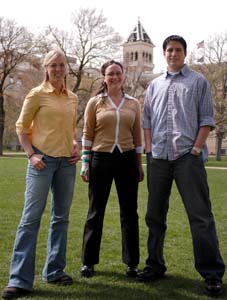
Two more USU students elected to prestigious national council
Two more Utah State University students have been elected to the National Leadership Council for The National Society of Collegiate Scholars (NSCS), leaving USU with a record of more students elected to the council than any other university in the United States.
Beckie Kimber, a senior at USU majoring in economics and political science, has served on the council for the past year as a regional representative and says students from USU have a long history of strong leadership in the NSCS.
Natalie Shupe, a sophomore majoring in speech language pathology, and John Wennergren, a junior in public health and pre-med, will both serve on the council next year, with Shupe serving as the vice president of administration, and Wennergren as a regional representative.
“USU students – they have a high caliber. People are happy to elect us because of the legacy we represent thus far and because of the projects we have implemented,” she said. “We have a very active chapter.”
Kimber said some of this year’s activities at USU have included putting a memorial in front of the Business Building in honor of fighting terrorism, and encouraging middle school students to pursue a college education.
The council is made up of 15 students from universities across the country and helps plan and run the NSCS organization, which strives to promote academics, leadership, and service among college students. Currently, 175 chapters and 250,000 members make up the NSCS.
The assistant director of leadership of NSCS, Derrick Thomas, said he believes so many of their leaders are coming from USU because many Utah students possess a belief system that embodies the qualities needed to lead and to serve. Thomas said NSCS leaders must possess two things-1) be concerned about people and 2) be motivated about the issues they see affecting their
community.
“When you look at leaders you look at vision. You look for leaders who are willing to take action,” he said.
USU encourages those kinds of qualities in its students, Kimber said.
“I’ve worked with students from Princeton and Harvard, and other very high ranking Ivy League schools and I don’t feel like they have any better of an education than I have. I feel the education I’ve received at USU has been very scholastic and beneficial,” she said.
“I became involved with the NSCS because of the three qualities that they represent–academics, leadership, and service,” Shupe said. “Those are all qualities that I want to possess myself. I think they are the most important things that college students should be focusing on.”
John Wennergren said he ran for a position on the council to become more aware of the opportunities the program offered and because of the importance of the values NSCS promotes.
“I know I have a lot of other friends who are members too, but they don’t hear much about it. I thought I’d take the initiative and make [NSCS] more well-known,” he said. “I am also a member Pi Kappa Alpha, and those are some of the same things we emphasize. Those qualities are the things I stand for.”
Each year, the council undergoes a week of training together and chooses a national initiative for the year. Kimber said this year’s initiative has been improving health among middle school and high school students, especially those problems relating to drug use and obesity.
“Each year the council has grown and they’ve been able to do new and different things,” Thomas said. “All leaders have continued to have success because of all the hard work people like Beckie have done to be good role models. Beckie’s been a leader out there doing positive things and doing things that people can see.”
Thomas said there are very few restrictions on what type of initiatives can be put in place, allowing each group to come up with its own unique service project.
“They want to make a difference, and we leave it right there,” Thomas said. “We purposely make it broad so anyone who wants to change the world in any way can become a part of NSCS leadership.”
Both Wennergren and Shupe say they have already started to develop ideas for next year’s initiative and are looking forward to training.
Shupe said she hopes to get students more involved with NSCS alumni. Wennergren said he would like to see college students become more involved with high school students by traveling to high schools and teaching students about their respective majors.
“I know when I first came to college I was at a loss at what to do. There are a plethora of things to get involved in but I didn’t have anyone come to my high school and talk to me about that,” Wennergren said.
Thomas said serving on the council can be challenging, requiring members to juggle several responsibilities at once.
“Their biggest obstacle is being students and being young. Their interests and priorities can change from one month to the next,” he said. “I enjoy seeing the ones who are committed. We as a national program are able to encourage them and support them. It’s fun to see them develop an idea, give them the support they need, and then watch them take and run with it.”
Because the council members are spread so far apart, Kimber said she felt the biggest challenge of being on the national council was communication.
“There are 11 of us and we live in different places across the United States. We have to rely on each other but we can’t see each other often,” she said. “It’s not like in the work environment where you interact constantly. You really have to trust each other to get each piece of the work done.”
Wennergren said he also hopes that people will become more involved with the local chapter of NSCS here at USU, especially the service projects.
“I think service projects are an awesome way to get people involved. Whenever you are helping the community people become more interested, it puts you in the spotlight,” he said.
Students are invited to join the NSCS their freshman or sophomore year after proving academic excellence with a 3.7 or higher GPA, Kimber said, and membership is lifetime.
“It encourages all students to reach academic excellence,” said Shupe. “It’s a great organization to get involved with.”
-bnelson@cc.usu.edu