
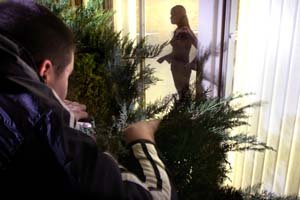
Stalking: A problem at USU?
While stalking is not an extremely common crime at Utah State University, campus officials say determining the exact number of stalking cases would be difficult.
Determining exactly how much stalking occurs on campus is difficult because incidents are not always reported. According to the Logan City Police Department’s annual report there were 15 reports and 10 arrests in 2002 for stalking.
“Perhaps [victims] are too scared they might aggravate the situation by reporting it,” said Campus Judicial Officer Dallin Phillips, who said he thinks stalking occurs more than it gets reported. Phillips said he thinks some students may not feel threatened enough to report their situation.
One USU student was approached by her stalker everywhere she went: While walking to class, in her college department and in a computer lab.
“I was getting so sick of not being able to sit in a public area because he was always coming around. No matter where I was, he would always come and try to talk to me,” said Mary, a junior studying at USU (Name has been changed.)
The situation lasted for one month during Fall Semester 2002 and didn’t end until an incident occurred that finally made her contact her resident assistant.
Mary said she hardly knew her alleged stalker or had any relationship with him. She and the man were both studying in the same college and lived in the same dormitory. She said he was an extreme environmental protester and encouraged her to sign petitions, even though she disagreed with his protesting viewpoints.
“We kind of made our peace and decided we could get along,” she said.
Despite any agreements, she said he still persistently encouraged her to sign petitions even though she continually refused.
“He would search me down, leave notes in my room. He was coming into my room when I wasn’t even there,” Mary said. “He would really try to force himself, his opinions and views.”
The man confronted her and a friend in the hallway near a commons area of the dormitory.
“He stepped up really close to my face and said, ‘I want you to sign this.’ I said I wasn’t comfortable and I didn’t want to,” Mary said.
After Mary asked him to respect her decision to not sign the petition, she said he moved toward her.
“I stepped back and [my friend] was standing beside me,” Mary said. The friend she was with had taken the Rape and Defense class and pulled her away from him, she said. The friend stood in between Mary and the man and told him that Mary didn’t want to talk to him and that it wasn’t a good time.
“[My friend] put her hand up and pulled me [into her apartment] and closed her front door. I was in [my friend’s] apartment and I needed to get to my apartment. So I went downstairs to get out the back door and he was already standing there,” she said.
Mary said he tried to “rip the door out” of her friend’s hand and said he needed to talk to her again.
“Since that has happened I’ve been a lot more conscious, it really freaked me out because I never had anybody approach me in the way that he did.
“I talked to my [resident assistant] about how he didn’t have any boundaries,” she said. Prior to the incident Mary said she thought he was trying to do something meaningful and I didn’t want to discourage him from doing that.
“But looking back on it, he was totally stepping over boundaries he shouldn’t have,” she said.
Mary said he started pushing the envelope and crossing boundaries when he showed up to see her during late hours.
“He would just walk into an apartment without knocking or anything, he would just walk into my room. Sometimes I would be asleep and wake up with notes under my door,” she said. “I was happy with Housing’s quick response in dealing with the situation.”
Mary said she wasn’t bothered after her resident assistant talked to him. “I have no idea what my R.A. said, but after that I had no more problems.”
Assistant Director for Residence Life Whitney Milligan said once an R.A. is aware of a situation, they first deal with the emotional and physical well-being of the student and then report situations to a residence director or area coordinators to determine if they need to get USU Campus Police involved.
“We take a report and see what the elements are,” said Lt. Steve Milne of Campus Police, adding that the police determine if the situation meets the stalking code and if a crime has been committed.
Laws and statutes vary from state to state. The Utah Code defines the stalking course of conduct as repeatedly maintaining visual or physical proximity to a person or repeatedly conveying verbal or written threats – threats implied by conduct, or a combination of both directed at or toward a person. Making threats to the immediate family of a person is also considered stalking.
Milne said the police often get called in stalking situations where one party doesn’t want a relationship to end. For situations that don’t involve prior relationships, Milne said, he thinks messages of not wanting to be contacted were made unclear to the person who is actively making the persistent contacts.
“It’s not a true harassment situation unless you have made it very clear,” Milligan said.
There are countless complaints or concerns of alleged stalking and Milne said he recalled only six cases reported to campus police that met the elements of the state code since 1996.
“A person may not feel comfortable confronting their stalker because they fear retaliation,” Milne said.
Milne said University police would be willing to help an individual confront someone who is bothering them or feels threatened by another person if they are hesitant to do it themselves.
He suggested that victims of stalking should contact the police if they feel incidents of stalking have persisted, especially if they feel they have already clearly conveyed boundaries with their stalker.
Milne said non-students who are causing annoyances to others and have no legitimate reasons for being on campus, such as taking classes or participating in school functions, can be banned from the
university.
USU has a judicial system independent from the police, Phillips said.
The Campus Judicial Board is made up of four students and two faculty members. At a hearing, the board would decide whether a student was stalking or not and what the penalty should be given for his or her actions.
“The judicial provisions of USU are more streamlined,” Phillips said. “The most I can do is kick them out of school.”
Procedurally, the student who is stalking would come in and work out an agreement, Phillips said. Some agreements could include suspension or expulsion from school.
“My sole interest is to determine the status of a student in [relation] to the university,” Phillips said. “It is not a higher test to meet, we don’t have to prove it by a reasonable doubt.”
He said a student can easily violate the school’s provision codes from the Code of Policies and Procedures while he or she is not meeting the police’s legal test of stalking.
“It’s hard to get a restraining order until something actually happens, unless that student violates a law,” said David Bush, a psychologist in the USU Counseling Center. “The police are limited in what they are able to do.”
“There [are] a lot of misconceptions with restraining orders, which have been around for years,” said Victim Advocate Myra Bogedahl of Cache County Victim Services. Bogedahl said restraining orders, which are issued and enforced by the court, do not have as much protection as protective orders and civil stalking injunctions.
Stalking injunctions were not offered in Utah until 2001 and didn’t give people protection in stalking situations that involved dating partners or strangers.
“It’s fairly new; we were just able to start prosecuting them,” she said.
Before then, only protection order
s were offered to married couples, people who have children together or those related by blood, Bogedahl said.
A person cannot be charged with anything unless they first have protection, such as with a protective order or stalking injunction. Cache Valley Victims Services refers people to the Community Abuse Prevention Services Agency (CAPSA) who can help them issue one. To issue a civil stalking injunction, a person needs to provide evidence to the court proving that he or she is being stalked. Evidence can be police reports, copies of e-mails, letters, or documentation of each contact. An injunction states guidelines for the stalker such as no phone calls, e-mails, or correspondences of any kind. The injunction lists areas a stalker needs to avoid such as the victim’s work and employment area. Violating the injunction is a Class-A misdemeanor and it only takes one incident for a perpetrator to be prosecuted, she said. But while being prosecuted it must be beyond a reasonable doubt, “there is no question that it happened,” Bogedahl said.
“If the judge finds that there is enough grounds to issue an injunction against this person then he’ll do that,” Milne said. If a stalker doesn’t obey requests even after an injunction has been placed, he said, the stalker has violated the code and can be charged with a crime.
After having the civil stalking injunction, perpetrators usually back off the person, Bogedahl said; if they have not, criminal stalking injunctions are placed after conviction. Violation of the criminal stalking injunction is a third-degree felony. Just because situations of stalking end doesn’t mean the stalking problem no longer exists-perpetrators can switch victims, she said.
According to a national study in a pamphlet from Cache County Victim Services, 77 percent of female victims and 64 percent of males knew their stalker. Eighty-seven percent of the stalkers identified by their victims were male. Fifty-nine percent of female and 30 percent of male victims were stalked by a former or current intimate partner.
“There are times when [coming over] is not appropriate, especially when it is a male going into a female’s dorm,” Mary said. “Social things that no one ever told you, but you just know.”
Looking back on the situation, Mary said her stalker used the petitions as a disguise to talk to her.
“He always had forms for me to sign; it wasn’t like he was just coming around,” Mary said.
Deciding what is appropriate behavior to accept is sometimes tricky for students to define, Bush said. He said he teaches incoming freshman about defining their boundaries for the Connections Program.
In the workplace there are laws to protect people from sexual harassment but, in dating it doesn’t work that way because everyone has a different standard in what constitutes sexual harassment, he said.
“Students just have to use good sense,” Bush said. “When I was a graduate student and I lived in the triad, I saw people who would be jogging back and forth in front of Valley View Towers looking for an opportunity to see somebody dressing or undressing.”
Bush said he thinks voyeurism or exhibitionism happens around college campuses, because “some students are careless, don’t shut their curtains and don’t use good judgment,” he said.
-doantn@cc.usu.edu