
The truth about booting
Everybody knows somebody that it’s happened to.
Whether running into a friend’s apartment to say hi, getting together with a study group or picking someone up for a date, the result was the same.
They got booted.
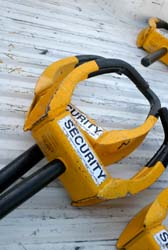
The little yellow device that clasps the rim of a car tire is costing students $50 for removal. And that’s no small price to pay, especially for a quick stop by a poor college student.
“I was only gone for, like, 20 minutes,” said Helen Brower, a junior in anthropology.
She was booted on Logan’s Main Street in front of Fuhriman’s Framing & Fine Art and Bitter Sweet. The spot she was in was reserved for patrons of Fuhriman’s, and she had even intended to go in there to get a picture framed. But going into Bitter Sweet first cost her $50.
Ron Liechty, who co-owns Cache Auto Booting Service with his wife, Holly, says that coughing up $50 is a lot cheaper than paying a tow truck.
“It’s anywhere from $125, $150, whatever,” Liechty said.
And the tow truck will set you back even less than tampering with the boot. The vigilantes who try to disable its kung fu grip have to pay for the boot itself, plus the booting. Liechty said there’s no way to remove the boot without breaking it.
Parking Authority manager Dan Lacy said that a boot-tamperer could even be taken to small claims court. He also mentioned that sometimes things don’t work in favor of the booting company. Premiere Parking was one company that didn’t make it in the booting business.
“Premiere Parking went out of business when they booted the mayor and didn’t have a business license,” Lacy said.
Another, University Parking Enforcement, pulled out near Christmas-time, said Lacy.
So, that leaves Cache Auto Booting Service, which Liechty bought about four years ago and runs as a side business.
But he makes sure that everything is legit. Liechty says he is very careful to follow all of the city regulations, including listing the fees and posting them on clearly visible signs. Following the law includes not being able to write tickets.
Many students don’t know that it’s illegal for private booters to ticket.
“Why didn’t they give me a warning first? It would have scared me enough not to park there again,” said McKel Wilson, a junior in literature studies who was booted March 15 at Island Inn Apartments.
Liechty, who only contracts with one commercial business and many apartments, gave several reasons for not issuing warnings or tickets. First, only law officers give tickets. Second, he wouldn’t have any way to keep track of who got warnings and who didn’t. And, booting deters illegal parking more than warnings or tickets, which students don’t care about as much.
Liechty’s storied experience with the ineffectiveness of warnings led him to the much more unpopular but efficient method of booting. He worked security for eight years, four of those with Oak Ridge Apartments, and found that warnings weren’t curbing the problem.
“We kept putting warnings and warnings and warnings, and they ignored them,” Liechty said, noting that at Oak Ridge the parking spaces were few, and paying tenants were being forced to park on the street. But then they tried booting.
“My gad, it was amazing how quick it took care of the problem,” Liechty said.
Early on in the days of booting, some students resorted to desperate measures with the little yellow clamps. Brian Smith, a 2002 graduate in marketing, remembers how one of his roommates finally got fed up and destroyed a boot at Old Farm. He was a construction worker who had access to a grinder, and he used the machine to free a girl trapped in the lot.
“He was just kind of a crusader,” Smith said.
But the crusader’s conscience finally got the best of him, and he anonymously paid for the boot.
Smith remembers Old Farm tenants putting superglue in the boot locks, throwing eggs at the “bootman’s” car, and even holding a mini-protest.
Undeclared freshman Clay Winder, the man who does almost all the attaching and removing of the boots for CABS, has dealt with some threatening customers.
“I’ve almost been beaten up three times,” said Winder, who makes $10 for each attachment and removal, said. “Booters are only doing their job.”
Many students now are well aware of that job, and generally try to steer clear of errant parking.
And Liechty, who deals with Old Farm, Glenwood, Continental, and many other housing units’ parking lots, says those lots are posted very well.
“We have them on entrances coming in, on buildings in the properties, we have them in several locations,” said Liechty, who deals with 17 or 18 complexes.
But not heeding the signs can lead to an unplanned reach into the wallet.
“I feel bad for the kids that get booted,” said Liechty, who carries a pager and takes all the calls. “If I came back and got booted, I’d be upset myself.”
But at the same time, Liechty added, he sympathizes with the complex owners who have almost lost control of their lots and their paying tenants who are often displaced by careless parkers.
Booting is most common among the private lots, but Utah State University and Logan also boot. But Lacy said Logan generally gives five tickets before booting, and USU dishes out four. Only Cache Auto Booting Service boots on first offense.
Therefore, it’s important to be prepared.
Liechty said that it’s up to students to look for the signs and realize that a short visit is still against the rules. He also stated that tenants have to caution their guests more.
“That’s what it comes down to virtually every time,” Liechty said, adding that the tenants should know whether or not their apartment boots.
So, the next time you or somebody you know gets booted, don’t say you weren’t warned.
-marklaroc@cc.usu.edu
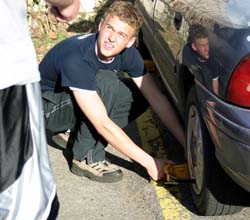
Cache Auto Booting Service worker Clay wWinder unlocks a boot from a car at Brentwood Apartments. Winder boots day and night, and sometimes has to leave class to remove a boot. (Photo by John Zsiray)