
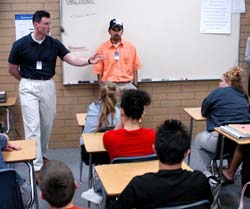
USU students explain Islam to middle schoolers
Mount Logan Middle School students had the opportunity to learn about Islam when Utah State University students from the Study Abroad program spoke to them last week.
Muhammad Hussain, a senior studying business information systems and agribusiness, and a life-long Muslim who lived most of his life in Pakistan, said he spoke to students in an effort to spread awareness about Islam and clarify for students some of the misunderstandings that have developed since Sept. 11.
“The most important thing [for students to understand] is that we’re not terrorists and that Islam … spreads peace, and it has never initiated war,” he said. “There is a lot more to the religion than media tells.”
Students were shown a video narrated by two Muslim children living in Cache Valley which showed the children participating in daily activities such as attending school, watching television and playing soccer.
“Our lives are a lot like your lives,” one narrator said.
The video also showed the children praying and involved in practices of their religion. Basic facts about Islam, including the five
pillars of Islam, information about the Quran, the Arabic language, how Islam is similar to and different from Christianity and Judaism and information about cultures in predominantly Muslim countries were also presented. Students were then encouraged to ask questions about what they had seen.
“In a lot of media people have an image of what Muslim is, and I’m not it,” said Alisa West, an American Muslim who converted to Islam in 1991.
West said she came to help students see there is not a stereotypical Muslim person and that Islam is a religion that encompasses all races and cultures.
“I really believe that our religion has been taken hostage by a few people that have gotten media attention and say what they want,” she said. “There are more similarities among people … Judaism, Christianity, and Muslim, than there are differences.”
West said she has also experienced Muslim culture outside of America when she lived in Saudi Arabia before the Gulf War. West now lives in Cache Valley where she manages a non-profit company.
During the question and answer period, students were allowed to handle objects and currency from the Middle East, as well as view a prayer rug brought by West and handle a copy of the Quran.
Eric Hilleman, a senior in political science who introduced himself to students as a Christian, said the project was funded by a grant in the Study Abroad program to help better educate junior high and elementary students about one of the world’s dominant religions.
Hilleman, who spent some time in the Middle East and studied Arabic, said his goal is to help students understand the diversity of the world.
Islam is one of the world’s largest religions with more than a billion people, or one-sixth of the world’s population, Hilleman told students. It is based on the teachings of Muhammad who Muslims believe was the last great prophet who followed other prophets like Moses and Jesus. The five pillars of Islam were presented in the video as confession of faith, daily prayers, charity, fasting and Hajj – or a trip to the holy city of Mecca once in one’s life for those who are not too poor or infirm to make the trip.
Hilleman told students to remember that while Islam is often associated with the Middle East, in reality only 20 percent of Muslims live in Arabic countries, and is also a predominant religion in countries such as India and Indonesia.
Mt. Logan students asked those presenting questions about many subjects ranging from the Arabic language to questions about currency. One student asked if the countries being discussed were those that “walked on coals.” Another asked for more details about the Islam calendar and wondered how birthdays were
celebrated.
Many of the questions were answered by the reply “it depends on the country” and all three presenters told students that many perceptions were of culture rather than religion.
West said that similar presentations have been planned for more adult audiences and will be used in high schools.
-bnelson@cc.usu.edu
By Brooke Nelson
Senior Writer
Mount Logan Middle School students had the opportunity to learn about Islam when Utah State University students from the Study Abroad program spoke to them last week.
Muhammad Hussain, a senior studying BIS and agribusiness, and a life-long Muslim who lived most of his life in Pakistan, said he spoke to students in an effort to spread awareness about Islam and clarify for students some of the misunderstandings that have developed since Sept. 11.
“The most important thing [for students to understand] is that we’re not terrorists and that Islam … spreads peace, and it has never initiated war,” he said. “There is a lot more to the religion than media tells.”
Students were shown a video narrated by two Muslim children living in Cache Valley which showed the children participating in daily activities such as attending school, watching television and playing soccer.
“Our lives are a lot like your lives,” one narrator said.
The video also showed the children praying and involved in practices of their religion. Basic facts about Islam, including the five pillars of Islam, information about the Quran, the Arabic language, how Islam is similar to and different from Christianity and Judaism and information about cultures in predominantly Muslim countries were also presented. Students were then encouraged to ask questions about what they had seen.
“In a lot of media people have an image of what Muslim is, and I’m not it,” said Alisa West, an American Muslim who converted to Islam in 1991.
West said she came to help students see there is not a stereotypical Muslim person and that Islam is a religion that encompasses all races and cultures.
“I really believe that our religion has been taken hostage by a few people that have gotten media attention and say what they want,” she said. “There are more similarities among people of the book, Judaism, Christianity, and Muslim, than there are differences.”
West said she has also experienced Muslim culture outside of America when she lived in Saudi Arabia before the Gulf War. West now lives in Cache Valley where she manages a non-profit company.
During the question and answer period, students were allowed to handle objects and currency from the Middle East, as well as view a prayer rug brought by West and handle a copy of the Quran.
Eric Hilleman, a senior in political science who introduced himself to students as a Christian, said the project was funded by a grant in the study abroad program to help better educate junior high and elementary students about one of the world’s most dominant religions.
Hilleman, who spent some time in the Middle East and studied Arabic, said his goal is to help students understand the diversity of the world.
Islam is one of the world’s largest religions with more than a billion people, or one-sixth of the world’s population, Hilleman told students. It is based on the teachings of Muhammad who Muslims believe was the last great prophet who followed other prophets like Moses and Jesus. The five pillars of Islam were presented in the video as confession of faith, daily prayers, charity, fasting and Hajj – or a trip to the holy city of Mecca once in one’s life for those who are not too poor or infirm to make the trip.
Hilleman told students to remember that while Islam is often associated with the Middle East, in reality only 20 percent of Muslims live in Arabic countries, and is also a predominant religion in countries such as India and Indonesia.
Mt. Logan students asked those presenting questions about many subjects ranging from the Arabic language to questions about currency. One student asked if the countries being discussed were those that “walked on coals.” Another asked for more details about the Islam calendar and wondered how birthdays were celebrated.
Many of the questions were answered by the reply “it depends on the country” and all three presenters told students that many perceptions were of culture rather than religion.
West said that similar presentations have been planned for more adult audiences and will be used in high schools.
-bnelson@cc.usu.edu