
The Lion the Witch and the Man
Imagine that, upon graduation, you’re given a choice: you can pick one author to study for the rest of your professional career.
With thousands of worthies lining the literary pantheon, which do you choose?
Jerry Root, a doctor of religion and philosophy at Wheaton College, said his professor urgedhim to pick an author to focus on in his graduate studies and professional career. He choose C.S. Lewis.
“I haven’t looked back since,” Root said.
“You don’t get an education in college, you get a foundation that you build on,” Jerry Root, said on Tuesday in the Taggart Student Center Auditorium. Sponsored by the Fellowship Of Christian University Students (FOCUS), Root came to Utah State University to give a lecture on C.S. Lewis and the world of Narnia he created. When he asked the audience how many had read the Chronicles of Narnia, nearly every hand in the auditorium shot up.
“I’m so happy to be among Lewis devotees,” Root said.
Root began by relating his experiences with Lewis’s writings in college. He started college as an athlete, but said his mind woke up in college and he started reading voraciously.
One day, he and his roommate road their 10-speed bicycles to San Franciso to meet his sister. While he was there, his sister gave him a copy of “The Lion, the Witch, and the Wardrobe,” which is the first book in the Chronicles of Narnia.
“I didn’t know books could be like that,” he said.
Root went on to write his masters and doctoral thesis on Lewis as well as several articles and was the co-editor of “The Quotable Lewis,” which has sold over 100,000 copies.
From the many themes of Lewis’s work, Root picked out some which he considered to be the most prevalent and the most important.
Among them is Lewis’s belief that there is an inconsolable longing in each of us for something more, something beyond the world as it now is.
“The literary have a need to go back to certain books and the reason why is that it awakens in them a desire for the world it describes,” Root said. “[But] it’s the nature of every play, holiday and childhood that it will end. Lewis captures the awakening of desire, in the world of literature, of something that transcends literature in the real world.”
The longing for something that doesn’t end, Root said, is what leads people to Christianity. Lewis, as he records in his autobiographical work “Surprised by Joy,” was an atheist for a good portion of his early life. Eventually, through searching and reasoning, he became a devout Christian. Root explained a similar reasoning for becoming a Christian, a decision he made as a college student in California.
“I’m a Christian because I know enough of my deficiencies to be devastated. I don’t think I could live life without forgiveness and without the love of God,” Root said.
Another main theme Root discussed was Lewis’s belief that reality is iconoclastic. An iconoclast is someone that breaks idols, or images of the past. These preconceptions and images must be broken before a person can move on, Root said.
“In denying reality, people lose their humanity,” Root said. “Lewis wrote, ‘I want God, not my idea of God; I want my neighbor, not my idea of my neighbor; I want myself, not my idea of myself.'”
Root answered audience questions on everything from the longing for desire in “The Screwtape Letters,” to what Turkish delight is.
Root ended by saying that with 72 titles spanning 11 genres, including literary criticism on authors from Boethius to Dante, Lewis had the ability to open up a reader to a wider world.
“You’ll never get to the bottom of it,” Root said.
For more information, contact Root at Jerry.Root@wheaton.edu.
-mattgo@cc.usu.edu

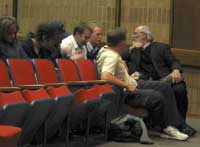
Jerry Root stayed after to talk to students for as long as they had questions. (Jamie Crane)