
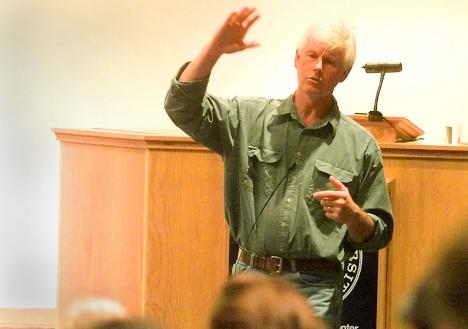
Career change led to ‘true calling’ for sculptor
Sculptor Patrick Dougherty says he doesn’t mind that his work is temporary, because he loves the process even more than the product.
In a slide slow and speech at the Eccles Conference Center Monday night, Dougherty showed photos of his large organic sculptures, mostly made with young tree branches.
Now a renowned artist who has worked in Japan, Ireland, Mexico, Italy, Denmark, England and all over the United States, Dougherty worked as a hospital administrator for six years.
“I suffered in that job, because I longed for something else,” said Dougherty, a North Carolina native who lives in a log cabin which he built. “I found my true calling.”
Dougherty then took some art history and sculpting courses, and instantly found what he was meant to do.
“The day that I walked through that door [to class] was the best day of my life, because I didn’t know there was anybody else like me,” Dougherty said.
So, Dougherty takes a fresh outsider’s approach to the artworld and the process of creating art, saying there is a big difference between “doers and viewers – people who make things and people who took them seriously.”
“I really love to make things,” he said. “I like handling materials and I like seeing my ideas going into three dimension.”
He also gave some advice on how to take advantage of artistic drive.
“Hysteria rides on the shoulder of every creative person, and if you want to get going immediately, you simply have to figure out how to harness your hysterical energy,” he said.
Marilyn Krannich, director of the visiting artist program, had to book Dougherty in spring of 2003.
“I’ve liked his work for a long time,” she said. “He’s very well-known, nationally and internationally.”
Because Dougherty’s pieces are made of sapling branches entwined and snagged together naturally, they are temporary. The longest sculptures last about five years, but they average about a year or so, he said. So, his work lives on only in photographs.
Jenny Hale, a graduate student in landscape architecture, thought the works conveyed movement.
“I just liked the motion in it,” she said.
The slides showed pieces done all over the world, and Dougherty, who has been sculpting for more than 20 years, said he makes three types of sculptures.
The first method is to build a sculpture that depends on man-made architecture for support. One cone-shaped piece on a house stood on a cone-shaped gable, like a dunce cap. Another in Washington, D.C. winded its way through a staircase.
Many years ago, Dougherty was commissioned to put a piece in the World Trade Center lobby. Since he was told it could not touch the walls, windows, or floor, he wove it through and placed it on a series of ladders, and he liked the turnout.
“Sometimes adversity is what makes a good piece,” Dougherty said.
Dougherty also uses trees for support. Some audience members gasped as he showed them a 42-foot high piece that surrounded a tree and was supported by it. He built it high partly so tourists in Irish double-decker buses could see it as they were whisked around a roundabout. Dougherty called another piece, built in some trees in Birmingham, England, a “roller coaster for squirrels.”
The final type of sculpture is independent of trees and architecture. Often these pieces lean on each other for support, or are carefully built with three sturdy “feet,” like a tripod.
Dougherty makes about 10 to 12 sculptures a year, and they usually take three weeks each. His schedule is already packed through 2005, and he’s working on 2006.
At the end of his presentation, one student asked him if he gets disheartened continually seeing his work get destroyed or sent to the dump.
“I’m used to it. I’m really more interested in the process,” Dougherty said, noting that most people, including doctors and lawyers, engage in temporary work.
“It’s the viewers who are more interested in the work staying up and seeing it through time,” he said. “I’m really more interested in the next work.”
At the end of his presentation, one student asked, “When are you going to make a piece at Utah State?”
“I need to do that,” Dougherty answered, as the audience cheered and clapped.
-marklaroc@cc.usu.edu