
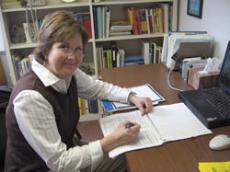
RAs give papers a renovation
For college students in the dorms, RA stands for a resident assistant. For those studying chemistry, RA is just another symbol on the periodic table. But many students at USU are not familiar with a different meaning for this abbreviation: the Rhetoric Associate.
Brittany Bacon, a senior in technical writing, is currently employed as an RA and said, “I think many students are surprised to discover that the university has an RA Program in general. Aside from the classes that have already integrated the RA Program into their course, many students I have spoken with are completely unaware of what RAs do, how the program functions and the wonderful benefits available to students through the RA Program.”
Julie Foust, director of the RA Program for five years, said the program is made up of 40 to 50 academically focused students who aid specific classes by reading and reviewing the students’ papers.
Under Foust’s direction, the program has doubled its number of RAs from its beginning 10 years ago. Its rapid growth may be due to the program’s objective, as Foust described, to help students become better writers. Foust said the program not only is a benefit to the students who receive advice on their papers, but it also acts as a benefit to the RAs, who enhance their own understanding of writing while teaching others.
“Our job is to be a second reader to the student’s paper,” said Steve Weller, a senior in English education and current RA. “We give our own advice on what they could do to make the paper flow easier during our individual conferences, but what the student chooses to do with that advice is purely up to them.”
Contrary to a common misconception, RAs are not required to be English majors, Foust said. In fact, some of the program’s best have majored in seemingly unrelated subjects like statistics and landscape architecture.
Foust said RAs are mainly required to be comfortable talking to students about writing and have confidence in their own writing skills. A Rhetoric Associate must also be responsible to set up their own conferences with students and prepare using time organization, one of the hardest and most important parts of their job, Foust said.
“It’s not always easy being an RA for one major reason: We’re students too,” Weller said. “We have our own homework and classes and papers to write, and sometimes the students we’re supposed to be helping don’t show up for appointments. That’s frustrating because we feel like we’ve been walked all over.”
Sita Bell, a senior who’s in the RA Program, described the most difficult part of her job as finding out how to critique a paper without discouraging the student.
Bell said, “Some students’ papers need almost a total renovation, and that is like walking a tight rope. Not being familiar with their psyche, it’s difficult to gauge how to approach that person.”
Patrick Shepherd, a junior in dietetics and RA said, however, most papers that are “in desperate need of either a life-preserver or a match” have usually been due to a lack of understanding regarding the assignment or a lack of time or effort, not necessarily writing skills.
Though these difficulties pose a challenge, most of the RAs continue on in the program until graduation and find that there are numerous benefits to their participation in the program.
Bacon said, “I have always enjoyed being able to help others feel more confident with writing and develop the potential of their personal writing style. It is supremely rewarding to be an RA and witness the progression of students’ writing skills.”
Foust said the most rewarding experiences come from watching the students excel as they gain confidence in helping others. She also measures the success of the RA Program from the professors that continue to use it and the difference they report in the students who take advantage of the advice they receive.
Bell said, “The most rewarding part of being an RA is how much it has helped me grow, both as a student and in dealing with people. When I’m conferencing with a student who has been struggling, and suddenly they have their ‘aha’ moment, it is quite rewarding.”
Foust said the program takes the skills the RAs already have and facilitates them to take on more. In addition to their opportunities to observe writing, RAs attend a beginning class where all the students have the same objective and they can talk about their experiences and learn from them.
They also are given opportunities to give presentations on what they have learned at annual writing conferences such as the Rocky Mountain Peer Tutoring Conference. These elements prepare students for graduate school and inspire personal growth, Foust said.
Overall, the scope of the largely unknown job of a Rhetoric Associate covers the ups and downs of writing and is largely a success, as Foust said, because of its opportunities for growth.
For more information on the RA Program, go to www.usu.edu/RAprogram/index.php. Those interested in applying to be an RA must submit an application before March 10. Professors interested in using the RA Program may contact Julie Foust at jfoust@english.usu.edu.
-cynthiadiane@cc.