
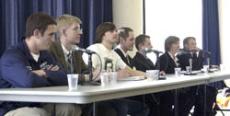
ASUSU presidential candidates square off
One candidate nearly stole the show and one didn’t show at all in the Associated Students of Utah State University primary presidential debate Wednesday.
Chris Garff, a junior in broadcast journalism, drew laughs from the crowd of about 50 mostly campaign-t-shirt-wearing students with candid comments that bordered on brazen while ostensibly scribbling his opponents’ comments on a notepad.
“I think in that position (of ASUSU president) people will listen to you and, uh… OK, Tooele High football rules,” he said when asked whether he felt he could get people to listen to him as a member of ASUSU.
Jason Nielson, a senior in international studies and political science, was unable to make it to the debate. The other seven candidates fielded questions about their ambition to become ASUSU’s top dog.
Candidates took turns pulling pre-determined questions out of a jar and then opened the panel to questions from the audience.
This year’s candidates’ qualifications range from involvement on campus to church leadership positions. Four of the candidates participated in ASUSU in some capacity this year, and all have shown some involvement in school activities or student government prior to this year.
“To be able to hit the ground running is one quality important for the student body president to have,” said presidential hopeful Peter McChesney, a senior in law and constitutional studies, when asked what qualities are necessary for a good president. “You must have a working knowledge of ASUSU. You finally figure it out in the second semester and then you get replaced. This year I was the HASS senator, and that gave me time to learn how it works.”
Garff’s daring didn’t stop at high school football. When asked why he was running for president, he said, “You get free tuition, and you get $400 a month. Plus, it looks great on a resume. And I would love to help out this wonderful school we go to.”
When asked for an explanation for his approach to his campaign, Garff said, “I feel there’s a lot of apathy towards voting on this campus. I want to relate to those people who don’t vote. I have never participated in these elections, and I want to get those people interested.”
The ideas discussed by the candidates varied from Staci Mecham’s goal to establish a central location students can go to get the exact information they need about anything relating to school, to McChesney’s goal to establish more scholarships not primarily based on a student’s GPA, but his or her leadership or service experiences, to Scott Ashment’s goal to boost enrollment.
“The biggest problem ASUSU can solve is the lack of information,” said Mecham, a senior majoring in speech communications. “People don’t know how to be informed. I would like to see a central location, like a Web site, you can go to with everything students need.” The site would include information about events on campus, deadlines for registering for or dropping classes and other administrative business.
Ashment, a senior in political science and economics, said the most important act he could do as president would be to boost enrollment.
“Keeping enrollment stable is the most important issue facing us,” he said.
Christian Brinton, a junior in international business, said the first thing he would do as president would be to continue the user-friendly campus initiative this year’s ASUSU has been working on. Brinton said that being a transfer student would help him in the role of president because he has seen how things work somewhere else and he could apply that knowledge at USU. Brinton said he feels finances and education are the main concerns of students.
When asked why he stands out from the other students running, Shawn Seamons, a junior in mathematics, said, “I am here for the students. I would like to solicit their views and be here for them.”
Mecham’s view of the presidency is similar to Seamons’.
“I got to see each office as administrative assistant to ASUSU. The thing I enjoy about the president is it’s a lot of everything,” she said. “I would have the opportunity to work with a lot of different people. I would represent the entire student body at large and not just one area of students.”
Zachary Ames, a senior in sociology and economics, was unfortunate enough to not receive any questions that allowed him to discuss his platform or ideas. Ames was chair for Noah Riley’s cabinet this year and said two of the best things ASUSU has done in the past couple years were the restructuring that separated the Executive Council from the Academic Senate and bringing free copies of the New York Times to campus.
Ames was also asked whether his support of the controversial mandatory health insurance bill would affect the way he represented the student body if elected.
“For the past year I have looked over research,” Ames said, “and I wouldn’t support it if I didn’t feel it was the right thing.”
The debate was attended by current president Riley, who said though he will miss being involved with ASUSU, he’s not sad to see elections starting up again.
“I’ve enjoyed it, but I’m ready to move on, graduate and get out into the world,” he said.
Each of the candidates seemed confident he or she could pick up where Riley left off, but it was Garff who summed it up:
“We could definitely keep the scene alive,” he said. “That would be rock ‘n’ roll.”
-ella@cc.usu.edu