
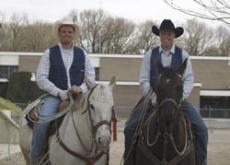
Team ropers riding high at No. 1
USU is finally getting recognition for a team ranked No. 1 in the nation, but it’s not in a sport one might expect.
Senior team roping duo Jon Reese and Chase Whitaker are currently ranked first in the nation in the team roping event after just one season of roping together. Just one rodeo stands in the way of a regional championship and a trip to the national rodeo competition in Casper, Wyo., in June.
“It makes us feel really good,” Reese said of the team’s national ranking. “We’ve practiced real hard to get here. In the fall rodeos, we were kind of sluggish. In the spring, we’ve been a lot more aggressive. I think it’s that aggressiveness that’s made us successful.”
The final rodeo before nationals will be held this weekend at Utah Valley State College. If Reese and Whitaker win the event, they will be awarded champion saddles worth $1,200 apiece and champion belt buckles that are awarded to the champion in each event, said Jeff Hall, coach of the rodeo team.
Hall said the duo is “sitting far enough above second place that nobody will beat them.” Reese and Whitaker said while they are glad they are ranked so high, they will still try their hardest at the rodeo for a shot at the champion saddle.
Though both Reese and Whitaker currently own champion saddles for team roping, they said winning a saddle at the college level would be a high honor as other saddles can be won after one good rodeo. The regional championship saddle is only won after nine rodeos in the regional circuit.
“I’ve just won (my) first saddle this last month,” Whitaker said. “I think winning this saddle – a college saddle – it will mean a lot more to me. It’s more prestigious. It took eight or nine rodeos to win that.”
The team-roping event consists of two ropers mounted on horseback with lassos who attempt to rope the head and feet of a steer in the shortest amount of time possible, Hall said. The roper who ropes the steer around the horns is called the header and the other partner who ropes the steer around the feet is called the heeler, he said.
The timing begins as soon as the chute housing the steer opens and the steer starts running, Reese said. The steer has a “weak string-like kite string” tied to its neck which is attached to a thin rope in front of the header, called the barrier, he said. Once the steer gets a running head start and breaks the barrier loose, the header and heeler leap out of the box, chase the steer, and the header ropes it around the neck, he said.
When the rope is securely around the neck of the steer, the header takes a dally, which means he wraps the rope around the horn of the saddle at least once, and allows the horse to pull the rope tight, slowing the movement of the steer, Reese said. The header then turns his horse and the steer that is attached by the rope so his partner, the heeler, can have his shot at roping the feet, he said.
“I’m going to want to get him roped and set him so Chase can come in and rope him,” Reese said. “I’ve got to make it as smooth as possible so Chase can have an easier time.”
While the header is chasing and roping the steer, the heeler follows at least 10 or 12 feet to the right of the steer and waits for the header to set the rope and turn the steer, Whitaker said. Once the steer has been turned, the heeler ropes the steer’s feet, takes a dally and turns to face his partner to stop the timing, he said.
“When you’re team roping, you need to rope together,” Whitaker said. “You predict what your partner’s doing. Jon makes it real easy to rope the feet.”
This sport originated during times of branding and has evolved to a rodeo sport that often sees roping times as low as five or six seconds in the professional rodeos, Hall said. The fastest time this season for Reese and Whitaker happened during their second run in the last rodeo, where they recorded a time of just 7.3 seconds, he said.
In a sport where time is of the essence, speed and precision are invaluable, and the duo has executed well enough to finish first or second in the last three rodeos, Whitaker said.
Even though the event lasts a mere handful of seconds, Whitaker said sometimes it seems like time slows down.
“It almost seems slow motion sometimes,” he said. “If it’s smooth, it seems slow.”
Reese said he prepares for the team-roping event by trying to pump himself up and praying for his horse to do what it’s supposed to.
“I offer a prayer that my horse will work good because sometimes he’s an idiot,” Reese said. “You got to have (a horse) that’s fast but controllable to make a good run.”
Though team roping doesn’t fall into the category of well-known sports, Reese said it still takes practice, dedication and a high level of athleticism.
“It’s a sport – a different form of a sport – but it takes the same amount of talent as professional basketball or pro football. The pros put their time in,” Reese said.
Reese and Whitaker have only been roping together for one year. Last year Whitaker roped with a female header who attended Idaho State University and placed fourth. He said it was difficult to trust his partner and know what she was going to do when he rarely had the chance to practice with her. He said he enjoys the ability to work with Reese more frequently, and it has helped them to be successful.
Reese and Whitaker will graduate following the regional and national rodeos, but that will not end their rodeo careers. Whitaker said he plans on competing in the Intermountain Pro Rodeos while Reese said he will continue to compete in local rodeos. Both said they do not want to pursue professional careers so they can spend more time with their families.
“They’re gone all the time,” Reese said of professional riders. “It’s not the life I want to live. I’ll still rodeo and compete, but I won’t go full-time. I wouldn’t want to do it full-time.”
-sethhawkins@cc.usu.edu