
Physics enthusiasts hold evening of experiments
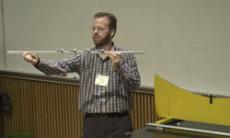
Physics teachers, students and enthusiasts gathered in the Eccles Science Learning Center auditorium Friday evening for a two-hour experiment demonstration. Physics professors from USU, Brigham Young University, Weber State University, University of Utah and Idaho State University presented and explained the physics of batteries, magnetics, friction and other properties in a round-robin format beginning at 7 p.m.
The demonstrations were part of a two-day conference, the 26th annual meeting of the Idaho-Utah section of the American Association of Physics Teachers.
Several demonstrations utilized the audience, of which more than one-third consisted of children. In one demonsration, 15 children stood in line and held copper and aluminum-plated sticks to generate voltage, making a “human battery.”
USU physics department head James Coburn led the battery power demonstration, showed how salt water can conduct electricity, and cut open a 9-volt battery.
Ziggy Peacock and Adam Beehler of the University of Utah did several experiments with small metal balls. They showed how by letting one ball roll into a row of others, the force is amplified on the last ball, causing it to shoot across the room.
“It is just like those pendulum-type swinging balls that you see sitting on an executive’s desk,” Peacock said.
Friction was demonstrated by Steve Shropshire of ISU, who claimed his start in physics came from shooting spitballs in his school days. He showed the audience a larger version of spitball phsyics using marshmallows and different lengths of PVC pipe.
“I discovered that mini-mallows fit perfectly into quarter-inch PVC pipe,” Shropshire said. “What a glorious day!”
He blew a marshmallow only a few feet using a short length of pipe, and then he increased distance using what he said was the same force of breath but with longer lengths of pipe. He finished with a piece of pipe about 3 feet long, which sent the marshmallow all the way to the top of the auditorium.
Then Shropshire repeated the experiment with a looped piece of pipe, “like the French horn I played in high school,” he said. The marshmallow went only a short distance like at the beginning of demonstration, and Shropshire asked the audience questions to deduce that the friction caused by the shape of the pipe slowed the force of the marshmallow.
“It is twice as long as the longest straight piece of pipe, but friction keeps it from shooting as far,” Shropshire said.
Demonstrators from BYU, Wayne Peterson and Robert Beck Clark, experimented with glow sticks on a spinning handle. They spun three glow sticks, one of each primary color, fast enough to make a white-light color wheel. With the lights off in the auditorium, they showed that one can influence the color of the wheel by dipping one glowstick in hot water to make it brighter and therefore dominant in the wheel.
Other events at the conference included an honor society induction dinner, presentations by various speakers and more demonstrations on Saturday. Participation was open to anyone interested in physics education.
-chelseyg@cc.usu.edu