
Defense shows growth and depth in early practices
Keep choppin’.
That was the rallying cry for USU’s defense last season. And spring football gives the Aggies a chance to do just that – keep choppin’ and working hard.
“Good things will happen if you keep working hard,” defensive coordinator Mark Johnson said. “It’s what you are as a defense – blue collar, nothing flashy. Let’s just work.”
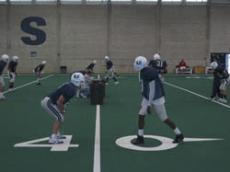
The Aggies had to do their work inside on Tuesday. The rainy weather and construction on the north end zone forced practice inside the Stan Laub Training Center. Johnson said this was because they didn’t want to tear up the practice field.
He said being inside is different, and the condensed space creates some challenges, like keeping players focused. But the drills take care of the focus and intensity, he added.
“No matter where we are, let’s keep the same intensity level and focus,” Johnson said. “Wherever we play, it doesn’t matter – they could plop us down in the middle of Candlestick Park – let’s go play. It doesn’t matter.”
So, under the metal roof of the indoor practice facility, the defense – wearing Aggie blue – set out to “chop some wood,” as Johnson puts it.
There are a lot of things to accomplish this spring. Johnson said they are looking to become better tacklers, play better against the run, get a better understanding of the defensive scheme and build depth at all positions.
The depth is bolstered by returning 11 players that started at least one game last year. These include defensive lineman Ben Calderwood, defensive backs Antonio and Caleb Taylor, and linebackers Devon Hall, Jake Hutton and Paul Igboeli – who was last season’s Western Athletic Conference freshman of the year.
But Johnson still stresses the importance of being able to go two-deep at every position. This was obvious when Hutton went down in the Aggies’ fourth game last year, and he had to be replaced by a slew of different linebackers, Johnson said.
Keeping players healthy is another important thing in spring practices. This is especially important because practices are full contact and in full pads.
“We got to have everybody healthy. We’re not good enough to not have everybody,” Johnson said.
But he added that they have been healthy so far, “knock on wood.”
This is evident by the lack of players sitting out of drills and the level of intensity of the players on the field. Every play of the 11-on-11 drills filled the Laub Center with the sound of shoulder pads popping. The defensive players on the sidelines cheered the big hits and interceptions.
The intensity even continued after the whistle had blown. One shoving match ensued between a blocker and a player trying to shed his block. It was quickly broken up.
Another such incident happened later in practice when a wide receiver and defensive back got tangled up after a pass was thrown their way. The two wrestled around on the green Astroturf for about a minute, while teammates and coaches tried to pull players away from the pile.
But Johnson doesn’t mind incidents like these – in fact, he likes them.
He said they’ve never had these mini-skirmishes before, but he sees it as a sign that guys are competing hard.
“It’s very healthy,” Johnson said. “It’s good as long as it doesn’t spill over and become negative …You need to be aggressive, but you’ve got to play within the rules. You can’t be an idiot.”
These incidents only momentarily interrupted the flow of practice, which started out with smaller groups of player doing drills and ended in a full 11-on-11 drill. That’s the schedule for every practice – start with inside run drills, move to 7-on-7 drills and end with team drills, Johnson said. Basically, they start with small groups, move to medium-sized groups and end with the large-group, team drills.
This strategy allows players to work on their individual fundamentals and technique, and still work on learning the defensive scheme, he said.
Depth is built by rotating in second and third teams on both sides of the ball. During the final 11-on-11 drill, where the offense ran a variety of plays against the defense, three different defensive units took turns against their corresponding offensive unit. Johnson said it’s important to get the second and third-string guys reps in practice.
Players also rotate in and out of individual-type drills designed to improve their pass rush or coverage skills.
These skills, along with an understanding of the defensive scheme are imperative, especially in the WAC, which features offensive powers like Boise State and Hawaii.
And the importance of the Aggies’ defense certainly isn’t lost on Johnson.
“(Defense) is huge,” he said. “You have to be able to play solid defense to survive. If you get into a scoring contest with people, you’re not going to be as successful, so it’s important to play well on defense. Defense wins championships.”
-dabake@cc.usu.edu