
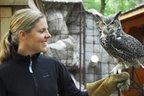
Caged In: A Day at the Zoo
When you care for about 400 animals a day, you can’t help but have a passion for them.
Superintendent of the Willow Park Zoo, Rod Wilhelm, said the animals are the reason he enjoys his job.
“You love the animals and you love the staff,” Wilhelm said. “We have many great people to work with. Diversity plays a major role, but that comes with the animals and the staff.”
Wilhelm has worked 28 years for the zoo. He said he started nine years after it opened in 1970, and he is currently responsible for collection and the overall operation of the Zoo.
Most of Wilhelm’s daily duties consist of animal care, construction, administration and maintenance of the park, he said.
“I put water out in the morning, do some feeding, do some administrative stuff, do some more feeding, then we usually have a brief meeting to oversee the day and coordinate what is going on and assignments for the different tasks,” Wilhelm said. “That is one of the good things about the job here – it never is the same.”
Karl Kallmeyer is the full-time zookeeper who deals with everything from feeding, finances and errands. He said he is responsible for depositing the money daily from the donation box, picking up day-old produce from Albertsons to feed animals, cleaning walkways and checking on animals.
“Sometimes we have the afternoon to ourselves to work on our own projects,” Kallmeyer said.
A lot of work and construction is being put into the new elk exhibit that should be completed this winter, he said.
Wilhelm said the zoo is also getting ready for another new exhibit this winter featuring capuchin monkeys. He also said he hopes to implant a black bear exhibit within the next few years.
“The animal count varies a lot when it’s the beginning of the breeding time; there is a lot more. We breed a lot of the birds,” Wilhelm said.
Some of the most exotic animals that can be seen at the zoo, he said, are the red-ruffed lemur, Bennet’s Wallaby’s and the water fowl.
Fall is the time to accomplish many tasks before the weather starts to cool down. Winterizing the equipment and animals is to be done before snow comes. And although Wilhelm said the staff is not there yet, they will soon be thinking about it.
For example, the tortoises have already been taken inside due to the weather changes.
“We try to choose most of our animals based on their ability to survive in our climate. However, not all can,” Wilhelm said.
Taking care of animals isn’t the only daily priority, he said. The staff spends a lot of time picking up limbs and leaves from the willow trees.
“There’s not a time of the year that willows don’t lose something. Any time the wind blows, you just cringe and wonder what the next morning looks like,” Wilhelm said.
But he said the worst part of his day is not picking up after trees, but picking up after people. Wilhelm said he also gets discouraged when guests feed animals that should not be fed.
Kallmeyer said dealing with people who hurt the animals is the least favorite part of his day. Cleaning up animal poop is not all that fun either, he said.
“A lot of the things we have to do are sad, and we shouldn’t have to do them,” Wilhelm said.
The zoo staff consists of a full-time education coordinator, two full-time keepers, part-time people that help with ship work, security personnel, part-timers that help on weekends and a few volunteers.
Between the handful of employees, they share responsibilities of plumbing, electrical, concrete, construction, lawn mowing, snow removal and whatever other maintenance jobs need to be done.
Willow Park Zoo is funded by the city, county, state and admission gate.
“The state funds Hogle Zoo at a certain dollar amount and we get a very small percentage of that being the only other official zoo in the state,” Wilhelm said. “So it sort of comes in the form of a contract grant with the city then runs the place for the state on that contract. The state doesn’t want to be in the zoo business, but they decided to fund the zoo that way. So there is the gate money and state money, then the city and county pick up the remainder of that balance of our budget.”
Wilhelm said the entrance fee is somewhat voluntary.
“We put up a sign that it is an admission. It used to say suggested donation, but because we are struggling to try and stay afloat, the government entities that support us continue to say we need to be more self-sufficient. We changed the sign a couple years ago to say admission, and we changed it last year to say one dollar for adults and 50 cents for kids,” Wilhelm said.
When asked what his favorite animal is at the zoo, Wilhelm said, “There’s just too many. Each animal has their own personality and some are more difficult than others. For example, the bull elk is extremely dangerous right now and doesn’t care what he hits.”
Kallmeyer said interacting with the animals makes his job worth it.
“Rod makes fun of me for talking to them,” Kallmeyer said.
The zoo covers about 10 acres and is located at 416 W. 700 South in Logan. It is open from 9 a.m. to sunset every day of the year except Thanksgiving, Christmas and New Year’s Day.
-T.Dixon@aggiemail.usu.edu