
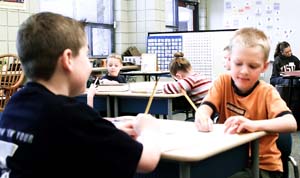
Edith Bowen students practice First Amendment rights
They may be the youngest journalists in the state.
Edith Bowen Laboratory School was chosen last year as one of three elementary schools in the nation to receive grants to be First Amendment schools.
Students have jumped at the chance to participate in the school’s new programs, which include a student newspaper and Student Citizenship Record cards.
“It’s about helping teachers to help students recognize their citizenship and diversity,” said Martha Ball, head of the state’s 3R program (Rights, Responsibilities and Respect).
Ball did a series of workshops with the faculty at Edith Bowen for about a year before she encouraged them to apply for the grant they now have.
“A group of parents went to the state core curriculum and pulled out goals that could go on the citizenship cards,” principal Kaye Rhees said.
The group is diverse, she said, and the cards have been a giant success. Students from kindergarten to fifth grade participate by completing the five objectives, as they are called – tailored to grade levels – and then when they’ve finished each student chooses a prize. They can pick from a First Amendment T-shirt or, as most of the children have, they can choose from the alternative charitable gift list in Rhees office.
“One student wanted to share in the bicycle program in Ghana,” Rhees said. “A kindergartner sent 20 fruit trees to Nicaragua.”
A young girl spoke to Rhees this week asking if she could choose from the alternative list and help globally by providing medicine for 100 people. Other gifts from that list include: Purchasing a day of groceries for one family in the United States, helping buy a wheelchair to someone in China and providing school supplies for one student in Afghanistan.
“The students are becoming more confident with adults,” Rhees said. “There is dialogue about diversity for the kids.”
Completing the cards is causing students to think globally, Ball said. The objectives include options for each student to choose from that exercise either their First Amendment rights or the responsibilities as a citizen.
“One third grader
interviewed a POW for their card,” Rhees said. “They only need to fill four lines with what they learned and this student turned in a two page report on the interview.”
Other ideas offered in the cards include studying the dance or art of another culture and then create your own dance or work of art from that culture, or read a book about the Declaration of Independence or the U.S. Constitution.
The student paper comes out once every three weeks and is run by intern Justin LaFeen from Utah State University. Older students can also choose to write an editorial for the paper from their card.
“The faculty picked up the [First Amendment] program 100 percent and the parents are completely involved,” Ball said.
She said the grant money she encouraged Edith Bowen to apply for is helping “handle religion in a natural place in the classroom.” The faculty, Ball added, is one of the finest she’s ever dealt with.
“You don’t just bring it up out of nowhere,” Ball said. “But if something erupts during class, all this training can help teachers and students to consider motives and diversity.”
Dorothy Dobson, a teacher at Edith Bowen, said the faculty wasn’t nervous about the program itself, just incorporating it into their curriculum.
“It might have been nervousness about the big time commitment,” she said.
Teachers had to realign their classroom lessons to incorporate the ideas of First Amendment rights – the right to assemble and the right to petition are incredibly important, Dobson said.
“It’s not teaching religion, it’s teaching about religion,” Rhees said.
She had two fifth grade girls come up to her last week and ask if they could have a protest. Rhees answered by saying yes, it is their right to do so. The girls were excited and after Rhees asked them what they were thinking of protesting they said nothing yet, but they just wanted to know if they could.
First Amendment rights are key for these children to understand and Rhees has seen many students leave Edith Bowen with a strong sense of citizenship even before the program began. One fifth-grader moved away a year ago and was very upset about the treatment of Tibetan people, so in his new school he’s started a petition to the Chinese government and incorporated other students into his passion.
Teachers, parents and students are benefiting from being a First Amendment school as it has become a vehicle for teaching and respect among all involved, Rhees said.
“It has become a part of the fabric of how we teach, not what we teach,” she said.
The First Amendment schools are part of a national program from the First Amendment Center and the Association of Supervision and Curriculum Development, through the Freedom Forum in Washington, D.C.
The other elementary schools are in California and South Carolina, but three junior high schools were part of the program, all in Utah as well.
The Edith Bowen Laboratory School has a year and a half left of federal grant money that has helped to change the students’ lives.
“It’s our determination and goal to have [the program] continue no matter what,” Rhees said.
-ireneh@cc.usu.edu
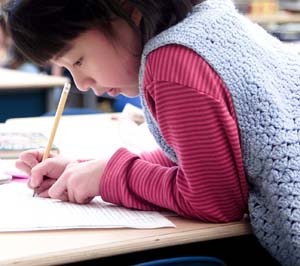
An Edith Bowen student works on her writing notebook during class. The school has a newspaper, Little Blue News, where many of the students´ writings are published. (Photo Jessica Alexander)