
The Age of Adaptation
A quick peek at the biggest Hollywood movies gracing the silver screen this summer may shed some light on the troubling future of the film industry:
1) An overwhelming lack of originality will give disenchanted movie-goers even more reasons to avoid theatres during the long summer months, unless they’re just itchin to see “Fast and the Furious: Tokyo Drift,” and “Titanic” knock-off extraordinaire “Poseidon.” (The original 1972 “Posiedon” was a less-than-inspired venture in the first place).
2) With nowhere to turn for narrative inspiration, the well-oiled comic book adaptation may be the only thing that can save the summer box office. (Well, that and the annual action entries from everyone’s favorite scientologist and Keith Richards impersonator). With the recent release of the Wachowski Brothers’ compelling call for anarchy, “V for Vendetta,” and the fevered anticipation surrounding the May release of “X-Men 3: The Last Stand” and the June release of “Superman Returns,” it appears that the faithful comic book adaptation is here to stay.
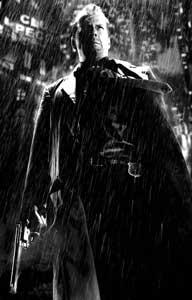
But for every mainstream, economic success like “Spiderman 2,” “Batman Begins,” every critical lauding of artsy renditions like Frank Miller’s “Sin City” or every award-winning adaptation like “A History of Violence,” comic book fans must also suffer through films that not only fail to capture the spirit of their source material, but support the preconception that comic books are only for kids and horny 30-year-olds that live in their parent’s basement.
But what determines a successful transition from the graphic novel format to the big screen?
Well, the question of whether or not the movie adaptation of a comic book actually resembles the orginal material ultimately takes a back seat to a more important concern on the surface:
Is the movie actually entertaining?
Obviously, if a film fails to gain an audience, whether or not it effectively adapts the comic book source successfully is irrelevant. Never mind the fact that Halle Berry’s bombastic turn as Catwoman had absolutely nothing to do with any previous version of the infamous feline fatale. The film itself was riddled with problems, not the least of which was the derivative supernatural origin of the film’s main character, overcooked action sequences, and campy performances from Berry and her co-stars.
There also seems to be a false correlation between films that borrow elements from their panel-based predecessors and justifiable success with adapting the material for a thriving box office venture.
While the “Daredevil” spin-off “Elektra” continued an arc that was based upon Frank Miller’s treatment of Marvel’s deadly assassin and drew many of its story elements from Elektra’s origin in the comics, the final big screen product removed all the moral ambiguity and character complexity from Miller’s stories and left viewers with an empty, B-movie style offering that focused more on Jennifer Garner’s cleavage than a viable story vehicle for a fan-favorite supporting “Daredevil” character.
Often, screenwriters take justifiable creative liberties with a project based on a graphic novel. For instance, Alan Moore originally wrote “V for Vendetta” in 1982 as a response to Thatcherism in the UK, but the Wachowski brothers made small adjustments that transformed V’s quest to topple Britain’s corrupt regime into an analogy for post 9/11 America and an examination of the destructive governments, giving the story more weight and relevance for a topically-minded demographic.
Despite the comic book medium’s glaring image-heavy similarities with film, a direct panel-to-shot transition ala “Sin City” isn’t always possible, especially when filmmakers are attempting to bring the multi-textual complexity of Alan Moore’s projects to theatres. As a result, Moore has completely disassociated himself with Hollywood’s efforts to take advantage of his work, especially after the movie adaptations like “From Hell” and “The League of Extraordinary Gentleman.”
The association between a faithful comic book adaptation and a critically lauded film release is not completely unfounded, however. In fact, many of the most successful motion picture adaptations have retained the visual quirks and narrative nuances of the comic industries’ most iconic concepts and characters. Sam Raimi’s “Spiderman” films echoed the same balance of fantastical escapism and somber precision of Stan Lee’s tortured, web-slinging everyman, while Christopher Nolan’s cerebral take on Batman brought the newly revitalized film franchise the same gritty, psychological subtext of Frank Miller and Dennis O’Neal’s revolutionary work.
But while these comic book adaptations remain faithful to their source material, their actual success can be attributed to the fact that they were professionally crafted films in their own right. The success of a comic book based movie does not rest solely with accuracy and awareness of the source material, but it often helps.
Mack Perry is a critic at the Utah Statesman. Comments and questions can be sent to him at mackp@cc.usu.edu.