
The whole wide world at USU
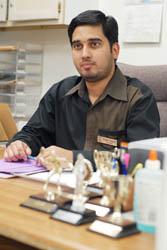
When Syed Sayem first heard of snow, he said he didn’t know how people would function or leave their homes when everything was covered with a blanket of white. He said he was confused, worried and a little bit scared. Now, after three years in Logan, Sayem said he likes the snow and has cleared its name in his home country, Bangladesh. Now his sister wants to see it.
Weather may be of little concern to many, but for international students, it may require a huge adjustment. For Sayem, the only student from Bangladesh enrolled at USU this semester, and other international students, the move to the United States also requires many adjustments. Aside from the change of seasons, international students must also worry about family and friends, the language, visas, immigration laws and their studies.
Sayem, president of the International Student Council and a senior majoring in computer science, said being without his family is the hardest part. He said he misses his family more than anything, but the American students and the large international student community at USU made the move easier.
The number of international students at USU may seem decent to many today but those who have seen past numbers, know it is fairly small in comparison.
In the 1980s, there were more than 1,100 international students. Today, there are around 750, numbers consistently reflecting the terms of foreign relations.
After Sept. 11, 2001, the number of international students at USU decreased due to a number of coinciding events. Recent developments, however, have started to increase the number of international students attending USU.
Steven Hanks, USU’s vice provost, said “Since 9/11, there has been a decline in numbers but in the last year or so, we’ve turned the corner. It is up compared to where we have been.”
Hanks said there were three main factors in lowering the numbers.
The first issue is visas. Since 9/11, the screening process has become more vigorous. Hanks said this has made studying at universities in the United States less attractive for some.
“There is a more vigorous screening process. It is beneficial in terms of homeland security but in terms of attracting international students, it is difficult,” he said.
According to www.unitedstatesvisas.gov, prior to Sept. 11, applicants had to fill out the appropriate application forms, provide photographs and pay a fee. Names were checked in a database for disqualifying information like some criminal charges. Forms were also studied for any questionable answers.
These terms still apply today. However, additional requirements must now be met.
To apply for visas now, students must be interviewed personally and fingerprinted. Applicants have to prove they will return home, strictly following the terms of their visa. The applicant’s security risk must be studied thoroughly and determined by a consular officer. Every student must fill out a supplemental application to help determine eligibility. Also, the student must prove financial backing. Their sponsor must make available an electronic file about the student to the government.
In addition to the grueling visa application process deterring student interest, other English speaking countries began to attract students to their institutions. Hanks said about the same time the U.S. increased security measures and tightened visa acceptance policies, other universities began aggressive recruitment. Countries like Australia, Canada and Great Britain saw an increase in international students because of their intensive campaigns.
Hanks said USU currently does not have an overseas campaign to recruit students. He said there are Web based resources but the school does not pursue anything aggressively. Most students hear of USU by word of mouth.
The third factor, Hanks said, is the improvement of educational institutions in foreign countries. As quality increases elsewhere, some students would prefer studying in their home country.
“In countries like China and India, there has been a rapid acceleration in their investment to higher education. The global quality is rising. It is very attractive to stay at home and study rather than go abroad,” he said.
Hanks said these trends were seen nationwide, not just at USU.
Also as a result of Sept. 11, international students are supervised more to make sure they are fulfilling their visa agreements and following immigration laws.
Fawn Groves, assistant director of the Office of International Students and Scholars, said once international students are on campus, that office monitors them. She said there are two immigration advisors who keep an eye on them to ensure they are following the terms of their visas.
Among other requirements, international students must study full time. Undergraduates are required to register for 12 credits and graduate students must enroll for nine credits.
Groves said international students cannot work off of campus without approval from the Department of Homeland Security. It must also relate to their major, she said.
Wherever they work, their hours are restricted.
“Work is obviously becoming more stringent since 9/11, not meaning they’re potential terrorists,” Groves said. “The greater reason is the protection of the American workforce and keeping American jobs secure to American citizens before opening the gate.”
Even though the amount of international students has slowly been picking up, Utah State is nowhere near the number of international students seen in the past.
Afton Tew, director of the International Student Office from 1987 to 1999, said there was a much larger community of international students while she was working at USU.
During her time on campus, Tew said the number of international students stayed between 1,000 and 1,100 consistently. Compared to the 769 international students enrolled at USU this semester, the decrease is obvious.
“It was a very different situation then,” Tew said. “We had a very different kind of student population.”
In the fall of 1980, she said she recalls there were around 250 students from Iran and 150 from other Middle Eastern countries. Today, according to the Office of International Students and Scholars, there are three students from Iran, three from Pakistan, three Jordanians and 28 from Saudi Arabia.
The bulk of international students today are from India, 142, the Dominican Republic, 138, and China, 125.
USU has a partnership with the Dominican Republic government to bring students here to study. Hanks said the Dominican Republic is the only country with which USU has a specific arrangement. The rest, he said, come on their own.
Tew said the amount of students coming to USU tends to strictly follow the state of world relations and affairs.
“The political and economic climate of the world influences where students come from,” she said.
During the 1980s when the U.S. began to have a rocky relationship with Middle Eastern countries, she said the number of students from that area dropped dramatically. The total of international students dropped to 800, the lowest Tew ever remembers seeing it.
Aside from different numbers and a very different makeup of the international student body, Tew said another noticeable change is the interaction between foreign students and Americans.
“Americans don’t really take advantage of international students,” she said. “An international student would go home after being here two, three, four years with friends from all over the world but not many American friends.”
Ann Roemer, director of the Intensive English Language Institute, agreed with Tew. However, she believes it goes both ways. International students could also make a greater effort to associate with American students, she said.
Roemer, who works closely with many foreign students w
hile teaching them English, said many international students are isolated by their study habits and restricted by the language barrier.
“I’m afraid some of our students are isolated socially,” she said. “You look different from everyone, you act differently. You don’t speak the language. Everyone around you knows how to fluently. It is a tremendous challenge when everything familiar to you is back home.”
-arie.k@aggiemail.usu.edu