
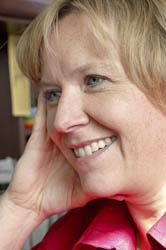
Professor Profile – Evelyn Funda
Associate professor in the English department, Evelyn Funda, said she wants her mother’s courage.
Her mother, Ántonia, escaped from the communist regime in 1949 at age 23 by crossing the Czech border into Austria while hiding in a false-bottomed wine barrel, Funda said. Communists, who she said had just swept Nazis out of Czechoslovakia, tried their hand at liberating the country until some Czech people realized the communists were just as bad as the Nazis.
While working as a nanny, Antonia realized the family she was working for was involved with the underground, which aimed at helping dissidents escape from the communist regime, Funda said. She soon became involved and eventually had to leave the country to ensure her safety. But one of the only ways she could do that, Funda said, was by wine barrel when the country exported grapes.
“This is like Napa Valley, Czech style,” she said. “This is real wine country, so a lot of grapes are transported to wineries and there was a false-bottomed barrel, so she escaped across the border into Austria.”
Consequently, Funda said her mother has kind of become a motto or theme to live by and remember.
“I’m a coward in lots of ways,” Funda said with a smile. “And that’s one of the regrets I have, that I didn’t do the things that I wished I’d done. I didn’t sort of push myself. And my mother, there was a sense of courage about her that I really admire.
This decision changed the rest of Ántonia’s life. She left without saying goodbye to her parents, Funda said, and didn’t ever see them alive again. Ántonia didn’t see her village again until 1993 when she went back with Funda’s dad, she said.
“You know, to face that kind of uncertainty, and she just did it,” Funda said. “It wasn’t as if she had a choice of course because what they knew at that point was the authorities were on to them and they were going to escape.
“(My mother) had visited her brother like a week before she left. And he was the only one that knew she was planning to escape. She had a boyfriend and so she had gone to her older brother and said I want to to stay because I love this man, and he said I don’t think you can do it.
“So she left everything.”
Funda, who teaches in the English and American studies department, said something her students don’t know about her is that her mother and father’s story is being compiled into a creative nonfiction book written by Funda herself. The book, which is not yet completed, came about after her family farm land in Idaho was sold, she said. The book delves into the metaphor of her family’s experience being compared to weeds.
“Weeds are particularly adapted to survive harsh conditions,” she said. “I kind of was interested in the idea of their resiliency.”
“Wild Oats,” which is a weed often found on road sides, is a title chapter in Funda’s book that talks about Ántonia and her immigration experience from her home country of Czechoslovakia to a small town in Idaho. Each chapter is named after a different kind of weed, she said.
Funda, who is “100 percent Czech,” said she compares a wild oat to her mother. When the awn (an appendage) of a wild oat is wet, Funda said it begins to unfurl or twist itself around its body since its position is at an angle. It’s an evolutionary thing, Funda said, that says this weed is amazingly adapted to survive.
“The reason I put (wild oats) in the book is because I’m really interested in the idea of the wild oats almost consciously making a choice to embed itself in the landscape,” she said. “So I kind of saw this as a metaphor for my mother who had been this refuge, I mean she literally had a refuge card, and I was interested in that idea of somebody who escaped, who was a refuge, of a very conscious effort of making yourself at home in a new place. So that’s why the wild oats.”
Funda, who received her doctorate degree from University of Nebraska-Lincoln, said she started to teach college once she entered her doctorate program. Her first teaching job, however, was three years prior at a high school in Yuma, Ariz., Funda said. Through that experience, Funda said she realized she didn’t really like teaching high school.
“The question was, how in the hell do we get out of Yuma, Ariz.?” she said. “And the answer was grad school.”
Funda said she came to do what she does almost “serendipitously” since she had never previously vowed she wanted to be a university professor.
“It was escape,” Funda said. “It was escape out of a town I didn’t like.”
Once she got in the midst of teaching and researching, Funda said she realized she really liked it. And since 1995, Funda has been at USU as a professor.
Melissa Davis, USU graduate in literary studies, said Funda is a successful teacher. Although Davis said she has never had Funda as a professor, she approached Funda to serve on her thesis committee. Funda spent a lot of time, Davis said, reading through drafts and meeting with Davis and other committee members.
“One of the most striking things about Dr. Funda is that she earnestly cares about students,” Davis said. “I was really impressed at her generosity and willingness to help me out, but the experience made it very clear that she immerses herself in teaching and genuinely wants students to succeed.”
Funda said her job is rewarding because of the classroom experience. With her students, Funda said there is usually a moment when they either reluctantly admit something is pretty interesting, or they get a spark in their eyes that makes her realize, she said, they are really engaged about what she is teaching them.
“That’s a high,” she said. “I can’t tell ya how many times I can be having just a crappy day and I go into the class and I come out 50 minutes later feeling great. It’s wonderful.”