
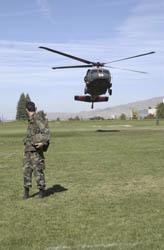
ROTC lands Black Hawk on USU HPER field
“The bird’s coming in! Get on the perimeter!” shouted Captain Jeff Bruce, as an air horn sounded.
As 54 Reserve Officer Training Corp (ROTC) cadets in camouflage uniforms and boots jogged to the edge of the HPER Field, a Black Hawk helicopter circled the building and landed, flattening the already short field and blowing grass around the people gathered there.
The Black Hawk was a lab for ROTC students in the military science classes.
“This is definitely the best lab we’ve had,” said Pablo Petruti, a student from Brazil.
Ten people ran to the chopper, ducking their heads underneath the nearly 27-foot blades, and sat down, buckling shoulder straps into a seat belt.
As the helicopter lifted off the field, the people on the ground were visibly pushed back by the wave of air coming from the 64-foot chopper.
The students were yelling and cheering as they were treated to a bird’s eye view of Logan and then the helicopter entered into the canyon. The people in the helicopter screamed as the helicopter rose and fell, alternately pushing the cadets against their seats and making their stomachs jump.
Then the Black Hawk went back to the field to empty its grinning and laughing load of people and take a new group of students.
Finance senior Brandon Pitcher said his favorite part of the ride was seeing the places he goes hiking in Logan and flying over his parent’s house.
The exercise was meant to give the students a treat, let them have a taste of what the Army was like and highlight the ROTC, Bruce said.
“People don’t know who we are,” said Lieutenant Colonel Tanya Olson. “They think military, but they’re just students.”
The ROTC program is based on making the students stronger leaders by focusing on core values like honor and integrity, Olson said. ROTC is meant to train student to become officers in the military.
“Whether or not they ever contract with the ROTC, they come back with stronger insight on leadership, communication, planning, executing,” Olson said. “They will recognize their weaknesses and strengths and continue to grow as a leader. How many 21-year-olds do you know that are responsible for 30 people?”
Any students may sign up for classes in military science without being part of ROTC, but some choose to contract, or join, the ROTC.
Leslie Haddock, a junior in exercise science, is the only female contracted with USU ROTC right now.
She said she joined ROTC because she had a friend in the Army who told her stories about the infantry and it seemed to be an adventure and fun.
“Overall, the guys are pretty cool, you just have to step up and be like, ‘I’m not a weak link just because I’m a female,'” Haddock said. “It’s like having a bunch of big brothers. It’s a good environment and a lot of fun.”
Olson said, “For a female, for me, it’s made me more confident and a stronger leader.”
After contracting with the ROTC, the new cadets are expected to be students first, Olson said. Depending on length of time in the program and other factors, students get paid different amounts of stipends and salary for their time and commitment, Olson said, and have their tuition paid for.
After graduating from school, cadets have a commitment of three years to the branch of military they signed up for, as either National Guard, Reserves or active duty.
Olson said, “When I went active duty, I was a platoon leader in Korea and had 30 people under me – half American and half Korean. It’s a full-time job. You’re responsible for lives and living conditions of these people.”
She said many of the cadets are planning on choosing to go active duty, but that it’s a very competitive market, because they are being chosen out of a group of 2,500 other cadets from various military academies and ROTC programs from other schools.
“When they get to that point, they aren’t that pretty green graduate student anymore. They are mature adults who are experienced with working with others,” Olson said.
Matt Merrill, a senior in business, said even though he is older than most of the other students, they are very mature. He said his biggest contribution is that he has had combat experience as a non-commissioned enlisted man, and can help people understand what the experience is like.
She said after spending that much time together, the people become like “another family you automatically inherit once you join any service.”
“We are in the business of people, not in the business of profit,” Olson said.
-dilewis@cc.usu.edu