
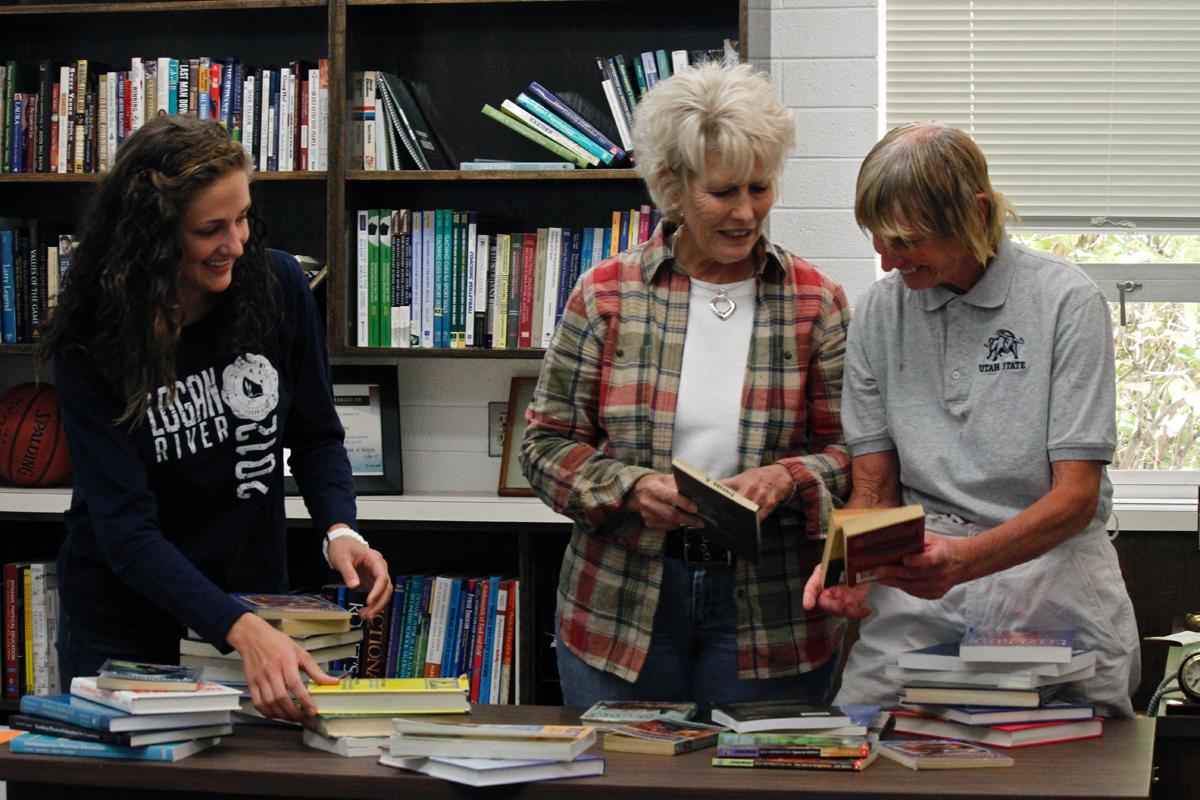
Physical Education Club collects books for reservation
USU’s Physical Education Club spent September taking action against poverty among the White Mountain Apache tribe in White River, Ariz.
Patsy Bradfield, a close friend of USU Professor and Physical Education Club advisor Hilda Fronske, started a book drive in late July after talking to a priest on the reservation.
Under the lead of Fronske, the club expanded the drive to include stocking hats, shirts, new gloves and mittens, all of which will be delivered to the reservation by Bradfield and her husband on Oct. 15.
“It has just been so great what everyone has done,” Bradfield said. “It has snowballed into a wonderful project.”
Though the humanitarian effort started started as a Cache Valley project, it quickly spread to USU, Bradfield said.
Donations of books, hats, gloves and shirts have been donated from the LDS church, the Bridger Elementary School’s Read Today program and USU students and faculty. Bradfield said one local woman by the name of Tamara Chambers donated 47 homemade stocking hats.
“Each hat takes a day to make, and she made 47,” Bradfield said.
She said she also had multiple children tell her of how they donated their favorite story book.
“We started with nothing,” said Fronske, “And now it has turned into this.”
The White Mountain Apache Indian Tribe is located on an impoverished Indian reservation located in Whiteriver, Arizona. The White River Indian Reservation is made up of three branches: Cibeque, Cedar Creek, and Whiteriver. Cibeque is the most impoverished of them all, according to Anna Reno, the secretary on the reservation. She said she believes Cibeque’s impoverishment is in part due to the fact that they are located a full hour away from the closest library and pre-school.
Reno said by the time the children of Cibeque enter school, they are intellectually behind.
“It just isn’t practical,” Reno said.
She said most of the families in Cibeque do not have cars, much less books. Their lack of transportation makes going to the library so impractical, it rarely happens.
Bradfield, Fronske and Daily Gardner, a senior majoring in parks and recreation and president of the Physical Education Club, have collected more than 1200 books, 320 shirts, 200 hats, and 60 gloves and mittens.
Fronske said the Physical Education Club will be accepting donations through Oct. 12 at 2 p.m. in the main office of the HPER building . She said they need books for ages nine through sixteen, brand new shirts size large or larger, brand new winter hats and brand new winter gloves and mittens.
“We really especially need gloves,” Fronske said.
The clothing and books will be distributed through the reservation on a need basis. Reno said there is a deep appreciation for the service among the White Mountain Apache Tribe.
“They give us hope,” Reno said, speaking of the people who have donated and helped with the book drive.
“Just the fact that someone knows and cares is huge, that someone who doesn’t even live in our state would give so freely and generously without expecting anything in return,” Reno said. “We trust that they will be repaid someday for this act of kindness and generosity that brings us together in human conditioning, which is what the world needs right now.”
Most of the books will be going to Cibeque branch. Reno said there will be no discrimination between who can use the books and some children will be able to take some books home to keep.
“Education is the keystone,” Bradfield said. “They need to have books to get out and see there is something more.”
The books are going to be sorted into age group, fiction and nonfiction by the Physical Education Club. When the sorted books get to Arizona, Reno’s sister Bernie Vorak will index all of the books and prepare them to be a part of a functioning library. The hope for the library is that it will give children an intellectual introduction prior to formal schooling.
“We are now connected in some way,” Reno said, “Which is what it is all about. This is going to affect the future along with the present.”
– jerawood@aggiemail.usu.edu