
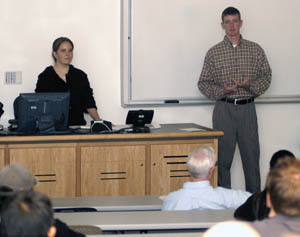
New engineering club offers borderless service
For John Sapp, president of the Utah State University chapter of Engineers Without Borders, the goal is “building a better world – one community at a time.”
And, after submitting applications for projects in Tibet, Kenya, Russia and Peru, the USU chapter of EWB is waiting for the green light from the national level – something Sapp said he expects in the next week.
Now the club just needs active members.
“It’s highly crucial [to get student involvement],” Sapp said after the club’s first meeting Thursday afternoon. “That’s the whole reason why we formed. To have members actually do things, instead of just having members.”
Formed as an official university club in September and an EWB chapter in October, EWB Vice President Jonathan Bingham said the club is looking for more than just engineers to help.
“It says engineers, but it’s for anyone who’s willing to help,” Bingham said.
Sapp and Bingham said the Tibetan and Kenyan projects would most likely receive approval.
“They were already projects that were designed through the national program,” Sapp said. “We’ll work with the Kenya chapter [of EWB.]”
The group is careful to not go where they are unwanted, Bingham said. The group’s Kenyan chapter submitted for help nationally, he said.
“When you start dealing with international anything, be it politics or projects, you have to respect what the community wants,” Bingham said.
In Kenya, the group would head an operation to provide drinking water and better irrigation to local communities. Still, the project also calls for improving poultry and dairy farming, said Cristina Nelson, a sophomore majoring in civil engineering.
“Even though it’s called Engineers Without Borders, there are some projects that won’t require engineers,” Sapp said. “Students and professors from different fields will definitely be needed.”
Financially, Bingham said project communities will provide what funding they can, but the USU chapter will be left to make up the difference. While a large percentage of cost will be alleviated by the volunteered labor, Sapp said the group has targeted professional groups for more funding.
“Our main focus is on the professional organizations,” Sapp said. “Large companies usually donate funding and also the professional assistance. The students themselves don’t actually have to pay anything for travel. It’s all provided by the funds that the chapter gets.”
Aside from monetary donations, Elizabeth Pederson, a sophomore majoring in civil engineering, said the group will still need help from professors and professionals alike.
“We need professors and other professionals because we, as students, are not ready to take on these projects by ourselves,” she said.
Engineering professor William Grenney, asked for students and professors to explore their connections in the professional community. Sapp said Grenney, the chapter’s adviser, was responsible for getting the group started.
Closer to home, the group is exploring a project to implement windmills in southern Utah. Bingham said work could begin as early as March.
Sapp said students who are interested in the group can submit their applications to the Civil and Environmental Engineering office.
-acf@cc.usu.edu