
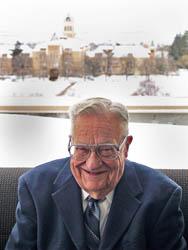
Prof works 20 years free of charge
If the old adage “time equals money” is true, then USU accountancy professor Jay H. Price Jr. has donated more than his fair share of both, teaching for 20 years without receiving so much as a penny in monetary compensation and donating thousands of dollars in scholarships.
Speaking of Price, Douglas A. Anderson, dean of the Jon M. Huntsman School of Business, said, “We estimate safely, some years ago he passed the $1 million contribution level in terms of the value of his time that he’s donated to us. He doesn’t donate only time, he also donates his financial means as well.”
Currently in his early 80s, Price, an Arthur Anderson Executive Professor of Accountancy in the Jon M. Huntsman School of Business, started teaching college at a time when most men hang up their ties and take to the golf course to enjoy a long-awaited retirement.
“I was never a golfer,” Price said.
Faced with a mandatory retirement from Arthur D. Anderson, a major accounting firm where he worked for 39 years and was a partner when he left, Price said he wanted to do something more with his life. Though he had multiple offers to provide private consulting work following his retirement, Price said what he really wanted to do was teach.
Looking for somewhere to teach, Price said he was alerted to USU when Orrin Colby – vice president and controller of Utah Power and Light, whom Price had worked with while at Arthur Anderson – told him he should check it out and brought him to campus. At the same time, he also had an offer to teach at Georgia State University, but decided on USU.
“I liked the people here, the people I’d met,” Price said. “It seemed like everybody was very nice, so I thought I’d give it a try for a year or so.”
The “year or so” expanded into a 20-year second career for Price, who has taught beginning, intermediate and advanced courses in accounting at USU during the spring semester, declining any payment and living off his savings, saying “I’ve never been a person to live high on the hog anyway.”
When asked why he opted to teach for free, Price said, “I didn’t take the pay because I didn’t need it, and I wanted to have the flexibility to say yes or no to teaching a course or when I taught.”
Price said he wanted to teach when and how he wanted to, and by refusing payment, that gave him that freedom.
“If you’re getting paid, you’ve got to do what your boss wants you to do,” he said.
During the fall semester, Price said he taught at his alma mater, the University of Wisconsin, Madison, for 10 years, also for free.
Two schools and 10 years later, Price had done it all without any monetary compensation, but it wasn’t without its toll on him. Nearly 75 at the time, Price said he was tired of traveling back and forth and wanted to try some other things.
“I just thought I was 75, or getting close to it, and maybe I ought to semi-retire, and I wanted to do some other things,” Price said. “I wanted to travel, and I was literally working full time, so I thought I’d like to take some time off and do some other things.”
So Price stopped teaching at the University of Wisconsin and traveled during the fall semester and continued teaching at USU during the spring semester. He said he decided to stay at USU instead of Wisconsin because “there was a time a few years ago at Utah State where the faculty was pretty stretched, the accounting faculty, and I felt like I was really filling a need.”
The need he filled was a big one, Anderson said.
“Here’s the kind of gentleman that really serves as a role model, not just for the students, but for the faculty,” Anderson said. “(He had a) successful career as a partner at Arthur Andersen, and then when he got to a stage in life when he had some financial security and was ready to retire, didn’t want to just go out and play golf or fish, not that there’s anything wrong with that, but wanted to give back and believed the best way he could do that was by getting involved with young people in college and sharing his life’s lessons and expertise from the world of a partner in a major accounting firm.”
Price said teaching has always been a dream of his, but he had never planned on teaching at the university level. When he started college, Price said he wasn’t exactly sure what he wanted to do with his life but thought about teaching high school. After two and a half years in the Army during World War II, Price was again faced with what to do with his educational pursuits.
“After I got out of the service, I took the VA interest test and it showed I ought to be an accountant. I asked the counselor, ‘What’s an accountant?’ He didn’t know, but I thought I’d give it a try, and it turned out to be exactly the right thing.”
Price said he worked through the accounting classes and at the same time took all the courses necessary to obtain a teaching certificate for high school teaching. Upon graduation, he had offers to teach high school or work in accounting with Arthur Andersen. Selecting the latter with the promise of better pay, Price set the tone for the rest of his life, but he always found ways to teach.
While in Chicago, Price said he taught Sunday school at St. Peter’s Episcopal Church for 25 years and spent many years working with underprivileged youth in the area.
“I just sort of felt like I wanted to be a teacher, and this was a way of doing it, and it was sort of a situation where nobody was doing it and it had to be done,” Price said. “I think it was rewarding. I don’t think I felt like I was saving the world or anything like that, but I wanted to be useful and thought I was helpful.”
While teaching has been an important part of Price’s life, he said how long he continues to teach will largely depend on his health, but said, “I’m fortunate I was endowed with reasonable good health.”
Having donated more than a million dollars in time, energy and resources to the university, Price may be what many call a success story, but he said if he were to do his life all over again, he would like to have gotten married.
“The one thing I always wondered about was should I have gotten married,” Price said. “I don’t think anything else in particular I would have changed because I had control over what I did. I think if anything, I was fortunate that I ended up in accounting and it turned out to be the right profession.”
Price said his contributions are part of a philosophy he has on life.
“I feel an obligation of trying to be as much service as you can to the public in some way, not just live for yourself,” he said.
-seth.h@aggiemail.usu.edu