
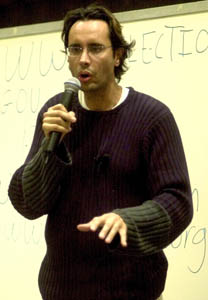
Activist encourages voter participation
The vote of young Americans could change this year’s election and Utah State University students should be part of it was the message from non-partisan political activist Jesus Nebot when he spoke to students Thursday.
Nebot, who moved to the United States during his teen years, was born in Spain and grew up under the dictatorship of Francisco Franco. Nebot said he remembers well the day Franco died and Spain celebrated, knowing they would finally be able to have their voices heard. The first election, 75 percent of the population of Spain voted, he said.
“Here you have the prom as a rite of passage,” Nebot said. “In Spain, it’s voting.”
This year’s candidates are not reaching out to the young people because young people are not voting enough, Nebot said. In 1971, when the voting age was changed to 18 allowing young people to vote, 49 percent of people ages 18-24 voted, he said. In the presidential election of 2000, 26 percent of people in the same age group voted. Nebot said if young people want the government to deal with their issues, they must get out and vote.
“This is the country where democracy was founded. This is the country that spreads democracy throughout the world. And this is the country that votes the least,” Nebot said.
Nebot asked students why they don’t, or won’t, vote. Student responses included not knowing enough about the issues, not registering in time, not having time, not feeling personally affected by the issues and thinking one vote wouldn’t make a difference.
However, Nebot said young people could determine the outcome of this year’s election. With the candidates in an apparent dead heat, young people, not likely counted in the statistics, could be the ones to make the difference, he said.
“This election depends on you guys,” Nebot said.
The choosing of the president of the United States is extremely important, Nebot said, because the United States president is the most powerful man in the world. Local issues are also important because they affect people very personally in their lives. Nebot said he feels Americans have become too passive.
Nebot gave the example of the 1960s when things were different and young people were so politically active, the Vietnam War was stopped due to their opinions.
“I feel that citizen means to really participate,” Nebot said.
Nebot then asked students to voice their opinions on the issues that are important to them. Students listed high taxes, tax breaks for college students, the war in Iraq, social security, unemployment, healthcare costs, education and the environment as top issues. Two students also gave opposing positions on Amendment 3.
Students also voiced differing opinions on the war in Iraq and mass weapons of destruction. Nebot said there were no weapons of mass destruction found in Iraq. Nebot said sometimes a belief in a certain position can be so strong that people neglect to research the issue and other views.
Voicing his own opinion only when asked, Nebot said it is questionable and debatable whether or not the United States should have invaded Iraq. Nebot said he feels there has been too much “reaction” to terrorists and not enough “reflection.” In Spain, the government tries to isolate terrorist groups and not “throw bombs.”
“The way the U.S. has reacted has made a more divided world,” Nebot said.
Nebot said he still respects the president of the United States and those who believe otherwise.
Calling voting not only a right, but a privilege and a civic duty, Nebot frequently validated students opinions on all sides of the issues and said students should continue to educate themselves and to vote. Students voiced concerns as to how they can know whom they can actually trust to follow through on their promises. Nebot said students should focus on how each individual voter can trust them and not distrust them by not paying attention to slander campaigns.
“He was really unpartisan and let the issues be brought up by the students so we could learn,” Natalie Cook, a senior majoring in political science, said.
To end his presentation, Nebot organized a mock election. Students divided themselves into a Republican Party, Democrat Party and undecided voters, each having about 10 participants in each group. The Republicans and Democrats each chose a presidential and vice presidential candidate to present the issues. Undecided voters were allowed to ask questions, as were the parties. At the end, the undecided voters were asked to make their decisions. The Democrat Party won the undecided voters by a large majority.
Nebot currently hosts the public television program “Tea with Jesus” where he talks to political leaders about various issues. He is also a filmmaker and recently released the film “Not turning back.”
-hilaryi@cc.usu.edu