
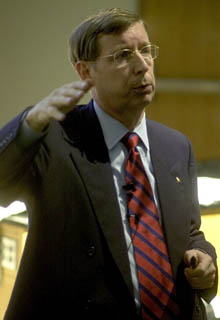
Hall explains tuition increase to students
After a 1 percent raise in faculty salaries over the past three years, increased professor wages are the primary focus of the newly proposed 43 percent tuition increase, Utah State University President Kermit L. Hall said Wednesday.
Hall and Executive Vice President and Provost Stan Albrecht spoke to group of about 50 USU students Wednesday evening in the Eccles Science Learning Center in an effort to answer questions concerning the proposed increase.
USU faculty make 16 percent less than its peer institutions, Hall said. Despite making 7 percent more in benefits, Hall said there is still a negative 9 percent margin for USU salaries. The faculty also has to pay premiums for health insurance for the first time.
“This is not a small matter, this is a major matter in the future of this institution,” Hall said. “We need more money.”
The university also has accumulated a $9.8 million deficit over the last four years in fuel and power, Albrecht said. Prior to the year 2000, the state made up the difference for increasing energy costs. However, as of 2000, the state has ceased to do so, leaving USU to accumulate this deficit, he said.
USU has become more efficient in fuel and power use, Hall said. Hall said he was not attacking the state Legislature because it has plenty of its own problems to deal with. He also said, however, that these are issues the state will have to deal with in the future.
The state legislature has not increased appropriations for departmental operating budgets for 15 years, Hall said. Also, Tier II tuition, tuition that the students pay that comes back to the university, has been used for the last two years to provide additional operating funds, he said.
After the presentation, Hall allowed questions from the students in an open-forum style discussion. Many different issues were brought up.
One student asked if they had considered leaving tuition at low levels in order to attract a larger number of students. Hall said that had been discussed, but that they came to the conclusion, “If we cut tuition by 20 percent, we cut our throat by 100 percent.”
Many more students expressed there concern over the increased tuition.
Hall responded, “We can’t be cheap and good simultaneously.”
Les Essig, the Associated Students of USU president, said afterward of Hall, “He’s keeping us from falling into mediocrity.”
The new, state-of-the-art library that will be completed a year from now was a topic of discussion. The state has, in the past, supported USU in its library operations, Hall said. However, those funds have become inadequate to meet the university’s needs, he said. Subscriptions have been cancelled and the university is unable to purchase new books and magazines due to the lack of funds and increasing costs of those items, Hall said.
Hall and Albrecht also discussed selective investments. USU has, in the past, put together faculty, staff and student committees to recommend different initiatives for funding, Hall said. Funding dollars have become limited and innovative projects are not being funded, Hall said.
Operations and maintenance costs are increasing for existing facilities. Hall said the funding that comes from the state Legislature has become inadequate to cover operations and maintenance for new facilities. Because of this, needed maintenance is not able to be done and basic operating costs are not being covered, he said.
In defense of the increased tuition proposal, “There are very few institutions in the U.S. that go out and tell their students what the tuition will be in three years,” Hall said.
USU does not have a large enough budget to keep it performing at its current level, he said. Hall said he does not want to lose hard working, capable teachers because of the low salary.
Hall’s presentation can be accessed from the USU home page and seen in its entirety, at www.usu.edu.
-kevmour@cc.usu.edu
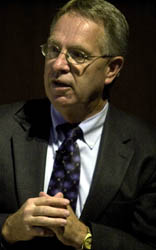
Executive Vice President Stan Albrecht was one of the administration members who answered questions about the tuition increase. (Photo by Michael Sharp)