
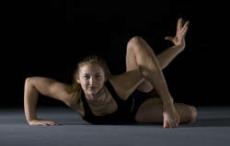
Bending into perfection
Cringing from the rips that form on their wrists and palms of their hands, Aggie gymnasts continually drive to be individual champions, 351 days a year.
Erik Kasabuske, graduate assistant strength coach who trains the gymnasts twice a week in the weight room, said Aggie gymnasts are a lot stronger physically compared to the average female athlete at USU.
The average gymnast, Kasabuske said, can record 40 to 50 push-ups a minute, squat 150 pounds in one setting and accomplish 10 handstand push-ups in one go.
“(Their push-up max) is definitely much higher than the average female athlete,” Kasabuske said. “If you compare them to other female athletes, weight-wise, they are very strong.”
With only two weeks off out of the year, in the offseason from May to December, gymnasts train in the weight room five to seven hours a week to prepare for competition season.
“We build them strong enough in the offseason to be ready for competition in the spring,” Kasabuske said.
For summer training, the athletes work on their cardio by running stairs, doing sprint workouts and piling on the summer mileage.
Combined together, the gymnasts receive a good variety of cross training and weight training year-round, Kasabuske said.
Sophomore Heather Heinrich, who started gymnastics at the age of 5, said although life as a gymnast can be demanding, the rewards are great.
“Seven, eight days a week I’m sore!” Heinrich said. “Each meet takes a huge toll on us, and our score is very physically and mentally demanding. We put our hearts and souls every day into this sport.”
First-year USU assistant coach DeEtte Kozlow, who has been coaching in gymnastics for 28 years, said muscle memory and visualization are the keys to a great gymnast.
“(The team) does daily training and do lots of reps and practice them to perfection,” she said. “This sport is extremely grueling that takes wear and tear on your body.”
Because this sport requires extreme physical fitness, but also equally as important, the mental focus, Heinrich said the coaches teach how to use imagery and visualization on a daily basis.
“They say if you have a rough day to go home and visualize a skill perfect and come to practice the next day,” Heinrich said. “We do every skill at least five times a day because repetition is engraved in our brain. For example, today I had to do 10 leap passes on beam because I had a rough time with it (at University of Denver).”
Kozlow said with the expertise in their basics, these gymnasts know how to to control every muscle in their body and use the correct technique.
Although grace and composure put into making routines make them look effortless in live competition, injuries, rips and blisters are hurdles gymnasts face along the way, Kozlow explained.
“They get rips on their hands and wrists from bars, and it’ll continue to rip and bleed, but they continue to work out like that,” Kozlow said. “On beam there are many girls who have bruised heels and missing toenails. It’s just part of being a gymnast. It’s tough, and they do this day in and day out, and they don’t complain very often.”
Junior Nicki Felley said though some days the workouts or practices can exceed her limits, but the hard days pay off as she anticipates and visualizes winning competitions. She added that gymnastics is not only physically demanding but also demanding on the mind.
“Sometimes I get home and crash because I’m so tired and exhausted,” Felley said. “It’s draining, but it’s all worth it.”
In high school, for Felley, practice ran 40 hours a week compared to 20 hours in collegiate gymnastics, where NCAA rules restrict gymnasts from practicing more than 20 hours.
“College gymnastics is so much more exciting than club gymnastics,” she said. “Everything that I did then is paying off now, and it does get hard some days, but you know in the end prize you have people cheering you on.”
Both Heinrich and Felley agreed some people perceive gymnastics as easy and a playful pastime, but the reality of it is the opposite.
“Sometimes people think that we just swing around a bar or dance pretty on floor in our leotard, but it’s different than that,” Heinrich said.
Felley said she looks to correct people of this misconception of just “flipping around and having fun.
“We train our butts off and push our bodies to the highest level we can get to,” she said. “It’s not as easy as it seems. There’s a lot of hard work and dedication behind it.”
-candice.sandness@aggiemail.usu.edu
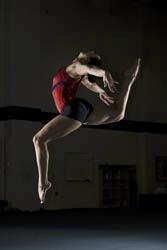
aggie freshman lyndsie boone illustrates a move on the balance beam.
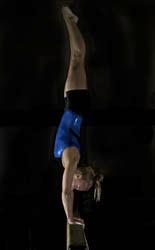
junior Nicki Felley demonstrates her floor routine..