
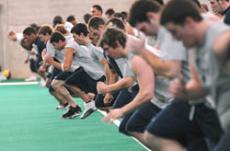
The balancing act of athletes
Dave Scholz, head strength and conditioning coach, said the biggest thing he helps USU athletes with is getting stronger.
“(We) get them able to control and move their body weight,” Scholz said. “And try to get them leaner, because a leaner person is going to have a better chance to move faster than a person that’s not so lean.”
Scholz said there are 11 USU teams the coaches see every day and who they are responsible for. However, each team has a different coach that leads them, and that differs in training. Their training depends on what point of the season they are in, what needs to be accomplished in terms of their training goals, and how specific each training is to their sport. Each workout is specialized for every team, he said.
Starting at 6 a.m., trainers follow an agenda to increase the physical and mental abilities of an athlete. The trainers teach athletes different cutting techniques, de-acceleration, and most importantly plyometrics. Scholz said he defines plyometrics as a scientific term for training the stretched shortening cycle. This means the muscles are trained to go from slow to fast or from a lengthening component to a shortening component. He said it helps athletes become quicker.
With only a few slots available for training, Scholz said he likes to teach USU athletes to be accountable, work hard, recover and eat the right way.
“Even though these kids train three days a week or whatever it might be, that’s really a small window of time, especially when you stretch it out over a four-year period,” he said. “It’s just not very much time to get them good, so we like to think of ourselves of keeping things simple, keeping it basic and getting good at a few different things.”
However, balancing the “double-whammer” of being a student and an athlete can be difficult, he said. To counteract fatigue of the body and mind, trainers stress the importance of a good diet.
“We really try to educate the kids as best as possible,” Scholz said. “That’s the best thing we can do.”
Alyssa Lowry, of the womens’ soccer team at USU, said many of her teammates are health conscious. Having full liability of their diet, athletes also have to withstand the responsibilities as a student, she said.
“We have tutors that are provided and people who help, but it’s difficult,” Lowry said.
Lamar Brown, who has been an athlete since the age of 10, said balancing school and track and field is stressful.
“When in season you’re doing work on the road, while on the airplane, and at the motel, but it’s natural,” Brown said. “I’m used to it.”
Teammate, Blake Hadfield, track and field jumper, said he agrees with Brown that athletes have to work on the road and do extra during the week at home.
“We try to get things done early,” Hadfield said.
Track and field assistant coach, Joel Johnson said the coaches preach to do the acadamic side first and try to be consistent with their studies and understand what’s expected of them.
The athletes hand in their school schedule to trainers and use it to determine which time slots are available for training sessions. However, Scholz said it is hard to get all team members together at the same time. The goal, he said, is to train a team setting. Scholz said training of athletes is sometimes just helping them be mentally dialed into what they are supposed to be doing.
-latadared@cc.usu.edu