

USU Study Abroad program expands
Opportunities for Utah State University students to study abroad are increasing as new exchange program placements are developing and the availability of scholarships has increased.
Kay Forsyth, director of the USU study abroad program, said many students are unaware of the opportunities study abroad offers, and how affordable the program is.
The study abroad program offers students the opportunity to study in another country for a semester, an academic year or a summer, Forsyth said. She said students can choose from a variety of programs, opting to study in English in more than 30 countries. For students wishing to build language skills, there are many placements available as well, in countries such as Austria, Estonia, Switzerland and Costa Rica, she said.
Most programs require at least two years, or the equivalent of two years, of language education before a student may study in another language, Forsyth said, but not all. As an example, she said there are opportunities for students to study Japanese, Spanish and Thai at all levels.
According to Forsyth, most of the placement programs offered through USU are based on USU tuition, room and board.
“Virtually for what it costs a student to study here at Utah State, they can study in another country,” Forsyth said. “We use the money that the student pays for their program here to host an exchange student in their place. Those students have paid at their international institution, and we’re merely switching students.”
Forsyth also said students may use academic scholarships, loans and Pell Grants to help finance the costs to study abroad. Scholarships are also available specific to studying abroad that many students are unaware of, she said.
“There are more available scholarships than there are students, so we need to get more students to take advantage of those,” Forsyth said.
In particular, she said there are many scholarships for students wishing to study in Asia. These scholarships, Forsyth said, include a settling-in allowance, monthly allowance, plus airfare there and back in addition to what the student would receive here at USU.
In addition to the exchange placement programs, there are also faculty-led summer programs that allow students to travel to another country for four to six weeks with a USU faculty member, Forsyth said. For summer 2005, there will be faculty-led programs at all levels of language skills to Germany, France and Chile, with programs offered in language and cultural studies, art and graphic design, she said.
Recently Forsyth returned from a trip to Russia, where she said she met with colleagues in international education to discuss the possibilities for expansion of study abroad opportunities for USU students, as well as to evaluate the program currently in operation.
Forsyth said the first Russian placement program offered through USU was developed this past fall with Kazan State University, in Kazan, a city east of Moscow. She said the university is located in a Tartar Stan Republic, which means it is a mix of Russian and Muslim cultures that coexist and co-habitant together.
“This offers a very interesting opportunity to learn the Russian language as well as meet and interact with people that are Muslims and speak their own language, such as Tartar,” Forsyth said.
While in Kazan, Forsyth said she was evaluating the program and its operation, since it was only just beginning. She said she wanted to know more about on-site facilities, the instruction students received, the amenities available to students and the living situations students experience.
“I would say that the education students receive is definitely comparable to what they would receive at USU,” Forsyth said. “Kazan is a very good institution – it’s a well-established, traditional institution, with small class sizes that allow students to receive a lot of individual attention, which is a definite advantage for students.”
Other institutions Forsyth visited while in Russia include St. Petersburg State University in Moscow, and Ivanovo University, in Ivanovo , in what is called the Golden Ring, an area of cultural interest, she said.
An agreement to send two USU students to St. Petersburg in February 2005 is currently under negotiation, as well as the possibility of creating a USU faculty-led program, Forsyth said.
USU students will not be the only ones to benefit from these expansions, Forsyth said. In the past it has been somewhat difficult for Russian students to secure the finances to come and study in the United States, she said.
“We’re hoping that with an exchange program, it will be easier for Russian students to come to the United States to study,” Forsyth said. “We’re also looking at ways of getting information to the Russian institutions encouraging Russian students to look at the possibility of obtaining advance degrees at Utah State. We’re looking at bringing students here as scholars to work with departments at USU.”
Forsyth also said she has examined the possibility of USU faculty and students collaborating with Russian institutes such as the Moscow Engineering Physics Institute, to combine efforts in scientific research.
“I really think that study abroad is a life-changing experience,” Forsyth said. “It’s an opportunity that may not come along more than once in your life. Students have the flexibility and freedom to experience a different culture that once you graduate and leave school and become somewhat burdened with responsibilities, you won’t have.”
For more information on the Study Abroad program, interested students may contact the Study Abroad office at (435) 797-0601, or visit the office in the Taggart Student Center Room 313.
-amberem@cc.usu.edu
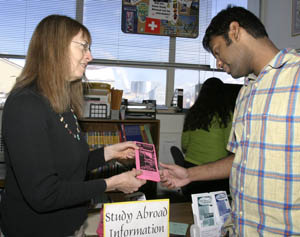
Kay Forsyth, Director of study abroad, and Vignesh Hariharan,an international student from India, discuss a studying abroad trip to France, in Room 313 of the Taggart Student Center. New exchange program placements are increasing study abroad opportunities for students. Most study abroad exchange programs are based on USU tuition, room and board. (Photo by Becky Blankenship)