
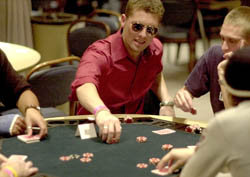
All proceeds went to children with AIDS during the Texas Hold’em poker tournament in the TSC Hold’em for Charity
It’s a scientific fact that you have got to know when to hold them and know when to fold them.
This weekend in the Taggart Student Center’s Sage Room many students learned these ancient truths the hard way.
Friday night the Sigma Phi Epsilon fraternity hosted their first annual Texas Hold’em Charity tournament. More than 170 people turned out to play and help the fraternity raise more than $2,000.
All money raised went to help Youth AIDS, a charity that provides treatment for children born with AIDS in Africa. The money raised from this event will help more than 200 children receive AIDS treatment during the next year.
Texas hold’em is a variation of poker that has grown a lot in popularity recently.
“We knew poker was hot,” Sigma Phi Epsilon’s activities chair and tournament go-to-guy Dave Osmond explained.
“When ESPN starts promoting something every hour, you know it’s big. We were looking for a way to combine a hobby with a fundraiser and this worked out perfectly,” Osmond added.
Players of all ages came from as far as Provo to take part in the event. Many wore cowboy hats or mobster style suits to get them in the poker spirit. Others wore lucky hats, sunglasses or shirts.
Texas Hold’em is played with each player being dealt two cards face down followed by a round of betting. The dealer then deals five community cards to the middle of the table, with an optional round of betting after the third, fourth and fifth card. After the bet is called players still in the game reveal their cards and the player with the best five-card hand, using any combination of their own and community cards, wins.
The tournament started at 7 p.m. with 20 tables. Players were given $120 worth of chips and spread across 20 tables. After an hour the top four players from each table were ushered out of the room while the event workers combined the games to 10 tables for the second round.
As the stakes rose players began feeling the pressure, expressed by nervous habits such a spinning or shuffling chips.
In the second round, Sam Hiatt, a junior majoring in mechanical engineering, experienced a wide range of poker-based emotions. After barely making it past the first round with $80 worth of chips he had acquired an impressive but undetermined number of chips.
“I didn’t count them,” Hiatt said. “It’s bad luck. There was at least 400.”
As three jacks turned up in the community hand Hiatt bet half of his chips. All the other players folded except Jason Stowe, a grad student in geography. After a minute or two of deliberating the chances Hiatt would have the other jack, Stowe called and the cards were flipped.
Stowe had a full house. Hiatt was bluffing.
“Statistically he made some bad calls but they definitely worked for him,” Hiatt said.
“He was at my first table so I had a pretty good feel for him and when he was bluffing,” Stowe explained. “I’m just playing luck tonight.”
As the second round closed, the 10 tables became five as the stakes rose again. After the third and fourth rounds, only eight players remained.
“I am all that is man,” exclaimed sophomore Zach Nesbit as he entered the final round as the all-around leader. Nesbit who doesn’t play poker regularly and only entered to support his friend who’s in the fraternity, had won more than $6,000 in chips.
In most tournaments the players keep the chips that they win in one round with them to the next round.
In this tournament it was decided well in advance to restart all players on equal footing with $2,000 in chips. However, it was not announced to the players until they were seated at the table.
“Some say this is a game of luck, others say it’s a game of skill,” Osmond explained. “We wanted to make it as much about skill as we could so we’re eliminating any advantage that could be gained simply by winning at a table that happened to have more people at it.”
The decision wasn’t popular with all the players, but Nesbit, who was hurt the most by the ruling, didn’t mind.
“I’m OK with it,” he said “I’m just here for fun.”
The final round was set up to encourage the most aggressive play of the night. Players made big bets more often than they had in the previous round.
One player, Jake Collette, who took sixth place, bet his entire winnings on one hand without even looking at his cards.
He lost.
In the end the top three winners were (first to third) Zach Clegg, Jase Sears and Steve Wright. For their victory they were awarded an MP3 player, a TV and a professional poker set respectively.
“It’s been a huge success,” Osmond said after the last game. “I’ve seen lots of hand shakes and good sportsmanship from players leaving the games.”
Organizers were generally happy with the event, even though there were a few problems with people not understanding the set-up of tournament.
“A few people got upset because it wasn’t like in Vegas where you could buy back into a game if you had bad luck,” Jared Westbroek, a senior majoring in law and constitutional studies, explained. “We did have a wild card tournament they could buy into though so it worked out.”
“I thought the chip break down was awful,” Sam Hiatt said. “It didn’t seem well thought out at all. It was their first time though. I’m sure next years will be better. I’ll be here for sure, I can’t turn down a game of poker.”
-steveshinney@cc.usu.edu