
NASA looks to make USU program national
A team of undergraduate researchers at Utah State University is negotiating the implementation of a nation-wide space education program with NASA.
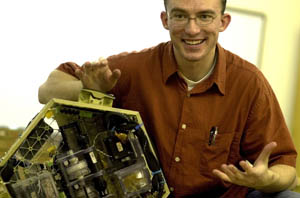
The Get Away Special (GAS) team is working to develop a fully functional model of the International (Space Station) Student Outreach Contained Research Available To Educators (ISO-CRATE), commonly called the “space box.” The box is designed to help students from kindergarten to college to be able to run experiments in zero gravity settings.
Founded in 1976 by former USU professor and Thiokol executive Gilbert Moore, the GAS team sent their first payload of experiments into space in 1984. From that time until 2001, the team sent a further 10 payloads into space. Each payload was built into a GAS container which held anywhere from eight -15 experiments, usually with four main experiments and several outreach experiments.
After the Columbia shuttle disaster in 2003, space research was suspended indefinitely. In the interim, the GAS team developed the ISO-CRATE to perform experiments aboard the K-bird which simulates a zero-gravity environment for approximately 25 second intervals.
“The advantage to the K-bird is that the students get to fly with the experiments and the safety standards aren’t as crazy as the space shuttle, so its not as expensive,” team coordinator and physics major Andrew Auman said.
Eight members of the GAS team traveled to Washington, D.C., last August to meet with top ranking NASA officials. Auman reported NASA was excited with the teams ISO-CRATE prototype.
“NASA is thinking of making this a national program,” Auman said. “We’re still in the legal process with NASA. If they take the program nationally, it will be very good for the university.”
Beyond the potential economic benefit, the program will increase USU’s reputation for high-quality undergraduate research.
“It won’t bring billions of dollars,” Auman said, “but it will bring some money and give the university a name because students across the nation, through our program here, will have an opportunity to do their experiments.”
Last Thursday, the GAS team held a meeting focused at recruiting students across campus to help in the push to take the ISO-CRATE’s nationally.
“[Implementing the program] all depends on how fast the students here at the university can work,” Auman said. “The faster, the better.”
The team’s goal is to have the ISO-CRATE reformed and adapted to the K-bird system by late spring. After another formal presentation at NASA, aimed at presenting the finalized product and giving formalized prices, the team will work during the summer to build the ISO-CRATEs NASA needs.
“Hopefully, by next spring, elementary kids will be doing their experiments on the K-bird,” Auman said.
Melissa Petersen works in the school of accountancy and joined the team last week to work in public relations.
“I thought it would be a really cool thing to be involved in,” Petersen said. “I think there are no boundaries for these guys. I really think the team can go anywhere.”
“Everyone seems to have heard that USU puts all these experiments into space, but they’ve never heard of the GAS team,” Auman said. “Its [the Space Dynamics Lab] and us who put all the experiments in space, so we want to get our name out there and let students know that anyone can get involved.”
Those interested in joining the team can contact Auman through e-mail at auman@cc.usu.edu. The team meets every Tuesday at 5 p.m. Due to the Thanksgiving break, there will be no meeting this week.
-mattgo@cc.usu.edu