
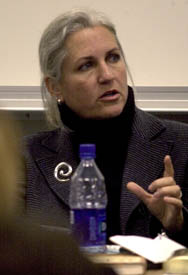
Author speaks about open minds, hearts
Utah author and activist Terry Tempest Williams spoke to a full house in the Eccles Conference Center Thursday night.
Utah State University students, faculty and members of the community listened as Williams read sections of her newest book, “Open Space Democracy.”
Williams said her new book is not about her personal political beliefs, although they are made obvious in the book. The book is about what it really means to live in a democracy and what binds people together as a nation and not what tears them apart, she said.
Reading from her book, Williams called open space room for differences, health of the environment being the wealth of communities, a reverence for life, creating alternatives together, cherishing the vitality of the struggle and the right to be insecure – just to name a few.
After being in Washington, D.C. during the Sept. 11, 2001 terrorism attacks, Williams said she wanted to offer something to the conversation as to what it means to be an American. After Sept. 11, she said she started to write in response whether it be a new meaning of Homeland Security or the National Parks of Southwestern Utah.
Williams said another turning point came when she spoke at the University of Utah’s commencement in May 2003. Since the nation had just gone to war Williams said she felt she needed to speak from the center of her belief system, knowing that some people would agree with her and some wouldn’t. She said she hoped to open hearts and not close them. When Williams finished, the audience both clapped and booed.
“It takes a lot more energy to boo than to clap,” she said.
Because “things in Utah get complicated easily,” Williams said she was afraid to face some of the members of her audience.
One such member was Sen. Bob Bennett, who, aside from being a senator, was her former neighbor and bishop in the Church of Jesus Christ of Latter-Day Saints.
Bennett expressed his dissent for her remarks and the two started to correspond through letters expressing their different views and writing about what they would give their lives for, she said. Williams said she found that meaningful conversation could occur, even when agreement didn’t, and that common ground can occur through shared experiences.
Williams also expressed her concern for natural wildlife, national parks, open lands and specifically the Arctic Wildlife Refuge. Williams said in this fundamentalist country it is important to remember what is fundamental and replace short-term gains with long-term strategies.
To achieve a more unified and understanding country, Williams said reflective activism is necessary.
“I do not believe we can look for leadership beyond ourselves,” she said.
Williams called the human heart the first home of democracy and that bravery lives in the hearts that have empathy – people must listen with their whole selves and give more than just opinions.
Williams, who came as a part of the USU department of English Speakers Series, also spoke of her recent stint at the Florida Gulf Coast University.
Williams said she was invited to speak at the freshman convocation on Oct. 24 at the university, but the president of the school opted to postpone the event for fear that she would criticize the Bush administration so close to the election. This was especially dangerous because the school’s Board of Trustees and state’s Board of Regents were appointed by Gov. Jeb Bush, she said.
“The president of the university said to me ‘when I see a hurricane coming I shut it down’. So I said, ‘what if it’s just a tempest?’ But there was no real humor in it,” Williams said.
Williams said she at first declined invitations to return later, but then “the students rose up in the name of free speech,” and invited her back and she went. Williams said she would die for the freedom of speech because she believes it is the door to all other freedoms.
“I thought she was marvelous. She’s an extraordinarily open person. Her openness shows in her writing,” said Grayson Osborne, a retired psychology faculty member.
“When she talks about expressions from her heart and how we should act toward each other you can feel it. In doing so, she speaks to the humanity in people.”
-hilaryi@cc.usu.edu