
The art of self defense
There’s a taste of the orient available to Utah State University students looking for more than sweet and sour chicken and a Jackie Chan movie.
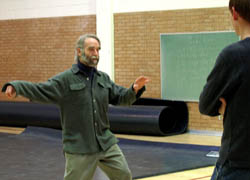
Every Tuesday and Thursday at 2:30 p.m., Kayo Robertson teaches a class in the HPER building as part of the USU self defense program. In the class students learn Tai Chi (pronounced Tai Ji) an ancient Chinese art of mediation and martial arts. Unlike other martial arts Tai Chi focuses on power through non-force.
The class is a favorite of many of the students taking it.
“It’s brought something new into my life,” Jake Gibson, a senior majoring in watershed science, said. “I took the class just because I had heard that it was good for mental and physical health and I’ve definitely noticed results. I leave class revitalized.”
“It’s relaxing,” Amanda Eaves added. “It’s a way to forget the stress of other classes.”
Robertson teaches his students more than just the forms and movements of Tai Chi. He also teaches them about its cultural importance in Chinese history as well as how to apply it into their own lives and understanding.
“All the key points of Tai Chi can be found in various forms through out Western culture,” Robertson teaches. “It is spread throughout though, be it in the Greek classics, the New Testament or quantum physics. All these principles that Tai Chi teaches are in there and having studied Tai Chi, it’s illuminated my understanding of our own culture.”
“I think that’s when we begin to have real understanding, when we can understand another culture and it shines light on our own from an different direction,” he added.
Robertson has been studying Tai Chi for over 25 years. For 15 years before that, he has also studied other martial arts where he reached the level of black belt.
“I started out in marital arts, like most people, on an overdose of teenage testosterone,” Robertson said.
“I enjoyed it but after a while I found that it’s just a lot of people jumping around shouting about self control when they’re really just developing latent inner violence”
Just as Robertson was trying to decide what to do with his life and was considering leaving martial arts forever, a friend introduced him to Tai Chi.
“I was so fascinated by it that I decided to move to San Francisco to study with my teacher, Benjamin Lou, and here I am, 25 years later, still trying to learn from him.”
Benjamin Lou is a high level Tai Chi teacher from Taiwan who recently stopped taking on new students.
Even after spending years learning the art of Tai Chi, Robertson had no intentions of teaching. However, while he was working as a beekeeper over the summer in Wyoming, a group of people out of Jackson wanted to study from Master Lou. Being in California at the time Master Lou told Robertson to teach them.
To help him overcome feelings of inadequacy, his teacher told Robertson, “a first grader is okay to teach preschool, if no second grader is available.”
After that first experience, Robertson continued to teach Tai Chi as well as teaching writing and other subjects in the public school system.
After being invited to do a presentation demo at USU, Robertson was invited to start teaching university classes last spring.
Robertson enjoys teaching the art from, hoping to help it remain true to its ancient roots.
Tai Chi is at a crossroads now. In America it’s divided into the competitive world where there is scoring and cash prizes and the medical world where it’s seen primarily viewed as a healthy new age dance.
“Tai Chi is definitely on the health care map,” Robertson explained. “Whether or not the martial arts side of things is preserved, the health benefits are here to stay.”
These benefits include toning muscle, developing bone structure, regulation of the immune system, reducing spinal degeneration and lowering stress levels. Currently California law allows for health insurance to cover the cost of Tai Chi instruction.
Despite the great growth in interest in Tai Chi’s health benefits, study of it’s martial art applications has lessened in recent years.
“The need just isn’t there anymore,” Robertson said. “It used to be that if you knew martial arts you could go anywhere and do anything. Now we can all go to Brigham City without being attacked by a gang of bandits, so martial arts have sort of fallen from their place.”
“Also gone are the days when Tai Chi was only taught through the teacher disciple relationship and if the others in the community thought you were diluting the art they would send someone to challenge you and close down your school.”
This lack of regulation has led to what Robertson calls a diffusion of the art. Many of other instructors have tried to start schools here in the valley but none of them lasted very long. Robertson says this may be because they had lost focus on the heart of the art.
Beyond teaching on campus Robertson is also the director of the Bear River Tai Chi Ch’uan Society and teaches a weekly class for students of all ages.
-steveshinney@cc.usu.edu
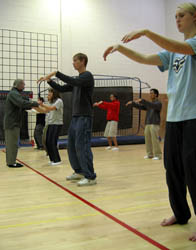
Robertson, the Tai Chi instructor, helps students relax and let the the stress of college life melt into the floor. (Photo by Jessica Alexander)