
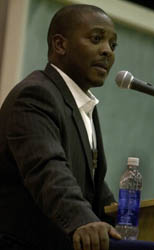
Speaker lectures on the end of apartheid
The son of Steve Biko, former human rights activist, spoke to students Monday about the importance of humanity and the end of apartheid in South Africa.
The lecture’s theme, “Cry Freedom,” was chosen to honor Biko and also indicates the media’s role and the impact it has, said Luthando Dziba, a graduate student in forest range science.
“[The lecture is] meant to remind us that the struggle for human rights is not over [around the world],” Dziba said.
Nkosinati Biko, Steve Biko’s son, spoke to more than 100 attendees about his father’s struggle to end apartheid in South Africa. Nkosinati said he will travel to several other states to speak about similar issues. He introduced himself to the audience and said it is a part of his culture to explain the meaning of his name. Nkosinati means “the road is with us.”
“I lost my father at the age of 7, he never saw me graduate,” Nkosinati said.
However, 1994 was the beginning of the end of apartheid in South Africa, he said, because the people wanted equality and began to demand it. People took to the streets and were “determined to bring apartheid to its knees,” Nkosinati said.
“As a nation, we have begun to shed a tear that has refused to drop,” he said.
Nkosinati said he has been lecturing about his father’s life since he was 15 years old. He thanked the students for attending the lecture.
“I’d like to extend my gratitude to each and every one of you who have [abandoned your busy] programs [today],” he said.
Steve was a key figure in the Black Consciousness movement in the 1970s, Nkosinati said. Earlier in his life, Steve didn’t show signs of political interest until his brother, Kyle, was arrested for his political activism, Nkosinati said. Steve was thrown out of school and blacklisted because of his affiliation with his brother, he said.
Steve developed a “healthy disregard for authority” after his brother’s arrest, Nkosinati said.
While Steve was at the University of Natal Medical School, he joined the National Union of South African Students, Nkosinati said. He was upset that the organization failed to represent blacks, Nkosinati said.
“Blacks were doing all the listening and their white counterparts were [doing all] the talking,” Nkosinati said about the NUSAS.
Until there came a time when all blacks could participate, “change would remain an ideal,” said Nkosinati about the struggles the blacks had in South Africa to obtain equality.
“The mind is the most powerful in the hands of the repressed,” Nkosinati said of the people’s determination to end apartheid.
The Black Consciousness movement began in the 1970s, he said, whereas prior to that, the people were categorized as either white or non-white.
“Black became a more definitive and positive term for us,” Nkosinati said.
Steve’s political activism drew the attention of the apartheid regime, which took action against Steve and exiled him in 1973, Nkosinati said. Steve was later killed while in custody of the police after he was arrested on unconfirmed reasons. He died of a “massive brain hemorrhage” while he was accompanied by five police officers, Nkosinati said.
“He was arrested a healthy man,” he said.
Nkosinati answered questions at the end of his lecture. Ted Pease, head of the journalism and communications department, asked Nkosinati to explain the impact of the western press and any misconceptions they may have about South Africa.
Nkosinati said South Africans are consumers of the western press and have seen depictions of the American society, which do not always portray accuracies of the American communities.
“They depiction of Africa, especially in Western America, is very, very negative,” he said.
Nkosinati said he suggests involving ordinary people in disseminating the information to correct the problem of under-representation and misconceptions about communities and other countries.
“Have ordinary people become participants of producing the media,” said Nkosinati, which would engage discussions among the people.
The lecture was in conjunction with International Education Week. Various facilities around the Utah State University campus supported Nkosinati’s lecture including the president’s office, department of history, the dean of the College of Humanities, Arts and Social Sciences and the department of journalism and communications.
-kcashton@cc.usu.edu