
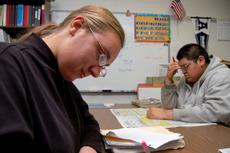
Project PEER works for assimilation
USU is offering a new program this year for young adults with developmental disabilities. The program, Project PEER, Post Secondary Education, Employment, and Research, involves students ages 18 through 22 who come from one of the four high schools in Cache Valley. Formerly offered on the high school level, the program was moved to the USU campus in January, bringing with it about 20 students.
The Project PEER Web site states, “The Center for Persons with Disabilities houses the program on the USU campus to facilitate students’ participation in social, recreational, and employment opportunities with other students of the same age.”
One of the program’s teachers, Chris Bartlett, said the purpose of the program is “to help them gain the skills they need for employment.”
Now that the program is on campus, the students have access to equipment, facilities and other resources that were not available at the high school level, Bartlett said. The students now have access to things like the Assistive Technology Lab and wood shop where they can learn skills and develop their various interests, Bartlett said. Several students have used the wood-working facilities to make wood chests for the school to use. Other students have been able to develop their computer skills in programs such as PowerPoint, thanks to these high tech facilities, Done said.
Some of the skills they learn and use on campus help them when they go to job training. During job training, these students perform various duties at many venues around campus. They do everything from working the cash register at the USU Bookstore to cleaning buses to busing tables at the Hub.
Kerry Done, teacher in the program, said jobs like those help the program participants feel like they are making a difference.
“It’s a positive thing for them to feel like they’re contributing to society,” Done said.
The students do not get paid for their job training, but the skills they learn are meant to be helpful in finding them employment in the future Bartlett said.
Bartlett said one disadvantage the students face is the prejudice of potential employers.
“The perception is, ‘Oh, they can’t do that,'” Bartlett said. “We’d like them to be challenged. Let’s see how far they can really go.”
Along with learning skills to have a job, the program teaches how to find a job. The students are taught how to apply for jobs, interviewing skills and how to be their own advocates Done said.
“They may not work full time,” Bartlett said. “And they don’t have that college degree, but hopefully they have those skills and the experience to go out in the community and get that job.”
Even though the students are on campus, they do not take courses through the university. Both teachers agreed they would eventually like their students to be able to sit in on classes that spark their interests. Done wants her students to “participate as much as possible in the college experience. College is more than going to classes.”
Their classroom, located in the Center for Persons with Disabilities, includes not only standard classroom materials but more unique elements such as a laundry facility. Along with job training, the students learn skills to help them live on their own such as banking, balancing check books, time telling, budgeting, nutrition and laundry. Through Project PEER, the students can also learn to get their food handler’s permits, which would be a benefit when looking for a job.
Done and Bartlett said they also have hopes of more integration of USU students into the program.
“There are currently several students who work with Project PEER students to help supervise their job trainings,” Bartlett said.
Although the program is located on USU’s campus, it is funded by the Logan City and Cache County school districts. Those districts also provide the transportation for the students to and from campus.
With the move onto campus, Bartlett said there have been some big changes for the students and the teachers alike. Bartlett and Done had both worked in different school districts before coming together on campus.
Although Done is a 15-year veteran and this is Bartlett’s first year of teaching special education, the move did not harbor conflict between the two. It’s now “our students, our classroom,” Done said. “It’s all about what’s best for the kids. It’s unified us as a classroom.”
The students have also been put in a new environment that has affected their learning, both academic and social. The students can now interact with people their own age Bartlett said.
“The bar has been raised, and we expect a lot more from the students,” Done said, adding that “they look out to campus for examples.”
The Disability Resource Center is currently cooperating with the the CPD to try and get more students to volunteer, Bartlett said. These students would come about one hour a week to help the students with job training, interviewing skills or socializing with other peers from campus. Now that the PEER students feel pride being Aggies, Bartlett boadted they also would like to attend campus events with fellow students.
Both Done and Bartlett said they are pleased with the amount of support and resources that the USU campus has provided so far.
“A lot of people are willing to help,” Bartlett said. “The move to USU’s campus has been an overwhelming success and has aided in the growth of students.”
“They don’t want to go back to Logan High,” Done said. “It’s been wonderful to be accepted. They’re just amazing people up here.”
-liz.w@aggiemail.usu.edu