
Cider
Apples are not only a delicious treat for Rich and Janet Weideman. They have become more of a lifestyle.
Paradise Valley Orchard, owned by the Weidemans, is a local business set in the back country of Cache Valley. Rich Weideman, a stay-at-home father, said owning an orchard and producing quality cider was not his life’s ambition, but he happened to stumble across the opportunity.
“We were on our way to Porcupine Reservoir for vacation when we saw the small orchard and decided to stop for some cider,” Weideman said. “We noticed the orchard was for sale and stopped to pick up some contact information from a local Realtor. We headed back home, but after three terrible days at work, I knew it was time to leave. So we purchased the orchard and moved out west.”
Years later, both of the Weidemans said they are now enjoying life on their land surrounded by apple trees, chickens, a dog and a cider mill.
“I have always loved cider, but once we moved out here, we couldn’t find good cider anywhere,” Weideman said. “That’s where it all began.”
When first beginning such a large investment, all Weideman knew about cider and orchards was that he liked it, he said. He said it took him time, effort and motivation to learn how to run an independent business.
“I can read,” Weideman said. “I read and researched all that I could. I was self-taught, and I had to teach myself a lot too.”
Weideman said one of the most important tasks while producing cider is to grow the correct variety of apples.
“You need to know the taste of each apple if you want to make good cider,” he said.
Weideman’s orchard grows multiple kinds of apples, but his favorite includes the Crispin apple, Honeycrisp apple and the Jonathon.
“All the apples we grow are great for cider, but these three are just great all-around apples,” he said. “These are great for both eating and cider.”
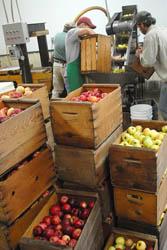
After each apple is picked, it is aged for a few days to help bring out the flavor of the specific apple, Weideman said. The aging process involves storing each apple in plastic crates and moving them into a cold storage room. The room is neatly organized, but contains mountains of these plastic crates stacked around the room.
“When making the cider, we only use apples you would eat,” Weideman said. “We will only use whole, sound fruit. If it is bruised or damaged in any way, we will throw it out.”
The apples advance through what is called the brusher and sorter. The brusher’s main duty is to remove the dust and dirt from the apples. The apples then proceed to the sorter, where the apples are sorted according to their size.
The apples are then elevated to the grinder, which grinds the apples into an applesauce-like mixture. The apples have finally reached the step Weideman believes is the key to making good cider.
“The slow press is what makes the good cider,” he said. “It is the key if you want quality cider.”
The slow press is what turns the applesauce mixture into juice. The mixture is put into special cloths that are placed in between heavy white press boards. These boards are stacked 10 layers high and placed on the slow press, Weideman said. The slow press slowly raises these boards and compacts the boards together, squeezing the juice out of the thick mixture.
“Making a quality product is all about using simple machines in the correct order,” Weideman said. “The machines we use are similar to those you would see at the bigger companies. Their machines would just contain more steel and other features.”
An hour’s hard work for the Weidemans will make close to 100 gallons of cider, he said. Weideman, along with his three-person crew, jugs the freshly pressed cider by hand and stores the cider in the cold storage, adjacent from the mountain high crates filled with apples.
“We usually will sell and estimated 100 to 150 gallons of cider a week,” Weideman said. “So we do this process quite frequently.”
Weideman’s crew consists of university and high school students who help out, not only in the process, but also in the clean-up.
“Cleanliness is one of the most important things to us,” he said. “The cleanliness of the process and even of the apple is very crucial. If the apple touches anything it is not supposed to, we will not use it. We will spend at least three hours cleaning up for a one-hour process.”
Paradise Valley Orchard has many outdoor features, from the picnic tables spread around the orchard to the opportunity for customers to pick their own apples off of the apples trees. However, aside from these perks, Paradise Valley Orchard is also known for one distinguishing characteristic, Weideman said.
“We do not pasteurize our cider,” Weideman said. “We are one of the last cider mills that do not too.”
Weideman’s choice to avoid the pasteurizing process has consequently resulted in not being able to sell his product in stores. Nevertheless, Weideman does not let that stop his business. He went straight to work to transform his old horse barn into a store, which he said is the perfect setting for the product.
“We basically sell fall,” Weideman said. “Aside from the cider, we have pick your own pumpkins and pick your own apples to mull cider and a favorite, maple apple sauce.”
Paradise Valley Orchard is located at 9971 S. Highway 165 in Paradise and is open from 1 to 6 p.m. seven days a week.
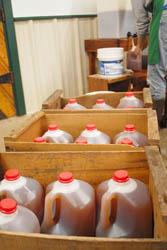
The finished cider is stored in bottles that rests in crates until the cider is used.
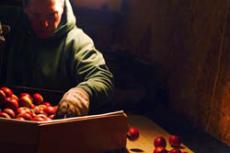
Rich Weideman pushes apples onto a machine that rubs and dusts off any apple leaves. After this, another worker will separate the bad apples from good ones.