
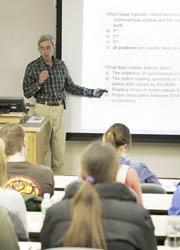
Students tuning in to mp3 players to study
As technology is advancing, the way USU students get their education is changing. One of the newest ways for students to learn from their professors is through online lectures. Greg Podgorski, an associate professor in biology, uses audio lectures in two forms in his classes. The first way is by podcast. Through podcasts, students can listen to past lectures directly from their iPods.
“My students wanted something so if they were driving somewhere, or if they were bored, they could listen to past lectures,” he said. “Podcasts let them do that.”
Another way Podgorski uses audio lecture recordings is through a program called Macromedia Breeze. This program records an audio track of the lecture and synchronizes it with feed directly from the professor’s computer. This way, Podgorski said, students can go back and listen to lectures as well as see the slide or visual image that would have been showed during the actual lecture.
“Students who use this technology properly can review any lecture,” he said. “If you don’t catch something the first time, you can listen again and get the information the second time.”
Scott Ensign, a professor in the chemistry and biochemistry department at USU, uses Macromedia Breeze as well as Blackboard and iClickers in his classrooms. One of his online PowerPoint presentations says it is better to provide online or homemade resources rather than to rely on “canned textbook resources.”
Some professors worry if they start using online educational measures, the negative side effects will be too great.
Tyler Bowles, a professor of economics, said he posts audio recordings on the Internet that correspond with PowerPoints from his lectures so students can revisit what they learned in class. Bowles said he also uses Blackboard extensively.
Bowles said some negative effects are simply inherent to the Internet, such as security issues and technological glitches. Students experienced these technological problems this week when Blackboard temporarily shut down.
Online education tools also take some effort from the students, Bowles said.
“It places more burden on students, and they need to be more aware of how to adhere to the honor code and complete their own work,” Bowles said. “Also, some students procrastinate, some students fall behind. With online assignments, it’s easy to lose track and fall behind.”
Brian Harker, a graduate student professor associated with the Center for Atmospheric and Space Sciences, said although audio lecture recordings and online tools could be great supplemental material, he worries they could damage the classroom.
“Some things you can’t do on the Internet with enough exposure,” Harker said. “Everything’s going online and it takes away from the classroom experience, which is essential.”
While the lectures are available free on the Internet, students still need proper equipment to be able to use them. Harker said it is unfair to students who can’t afford the high costs of new technology.
“Some things like iClickers can be bought in the (USU) Bookstore,” Harker said. “In the end, it’s just another piece of equipment you have to buy along with your books. It’s just another cost.”
Podgorski said one of the biggest fears USU professors have is attendance might drop as professors put more tools on the Internet.
“There is the worry that students will start to feel like they can just pick up the lecture online,” he said. “Nothing can switch the experience of being in class for the lecture. You simply don’t get the same learning.”
Despite this fear, Podgorski said he hasn’t seen any drop in his classroom attendance since he began using online audio recordings.
“I have seen the benefits outweigh the potential downsides,” Podgorski said. “I like what I’ve seen so far.”