
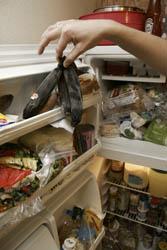
Attack of the Student Fridge
Pickles in a yogurt container, a month-old Arby’s sandwich and black bananas are just a few items that grace the shelves of USU students’ fridges and freezers. Amanda Price, sophomore majoring in exercise science, said it’s hard to keep a fridge clean and free of rotting food with six girls in one apartment.
“Probably the worst thing I’ve ever found is moldy tofu,” Price said. “It was all green and white and nasty.”
Freshman psychology major Ian Thorley said he once found rotten spaghetti squash that had been left uncovered and smelled horrible. Both he and his roommates throw out rotten food as it appears, but “there has been no formal cleaning of the fridge yet,” Thorley said, as he gestured to a three-week soda spill.
Price said she and her roommates try to organize their fridge by giving a separate shelf to each roommate, which works most of the time. She shares milk and cooks meals with one of her roommates, but because the other girls have such different eating habits, sharing everything is impossible, she said. Price said she also tries to conserve space in other ways like putting pickles in a yogurt container because it takes less room than a big jar.
Thorley said he and his roommates don’t have to worry so much about sharing food and conserving space. The six boys live mostly off frozen and microwavable foods, or foods their parents send from home, he said. Thorley said sometimes they organize food by size, but it “mostly just gets hucked in there.”
Food safety rules sometimes get pushed to the back when college students live together.
“There are rules?” Thorley said.
He said he knows about botchalism, but he doesn’t really worry about food poisoning unless he sees some sort of bulging can.
Matt McGrath, undeclared freshman, said he agrees.
“Generally, if it smells and looks fine, I’ll eat it,” he said.
Price said she has a food handler’s permit, but she doesn’t stress about following sanitizing and temperature rules.
Jackie Russell, her roommate, said she doesn’t notice those things too much.
“Germs don’t exist in college,” said Russell, sophomore majoring in psychology.
Both girls check expiration dates periodically, but Price said she usually keeps food like milk about a week longer or until it smells rotten.
Jill Hicken, freshman majoring in physical education, said she doesn’t worry too much about getting a food-borne illness.
“I just make sure I wash my hands, and I don’t let food sit out,” Hicken said.
Brian Nummer, USU Extension food safety specialist, said studies have shown that because students are generally busier, younger and healthier than other people, they are more likely to ignore food safety rules. He said students don’t always notice when they have a food-borne illness, nor do they report it, which makes researching the effects of not following food safety rules difficult. However, Nummer said cases of diarrhea and the so-called 24-hour stomach flu are both good indications that a person has eaten contaminated food.
One issue with students and food safety is not putting perishable food away, he said.
“Students will often buy a pizza one night, leave it sitting on the counter, and then eat the rest the next morning,” Nummer said. “Food should really be refrigerated within 2 hours.”
Nummer also said chances of spreading bacteria increase with the number of people living in the same area. Because students are often crowded into smaller spaces, they are at a higher risk for becoming infected. Nummer suggests students wash hands before and after dealing with food, or if that’s not possible, keep a dispenser of hand sanitizer on hand. Nummer said if students don’t follow any other safety rules, they should remember that “better hygiene mean(s) fewer illnesses.”
-alisa.lyman@aggiemail.usu.edu