
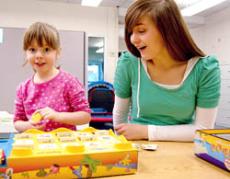
USU’s Autistic Efforts
The Autism Support Services: Education, Research, and Training program at USU was awarded the Autism Council of Utah’s education Autism Program of the Year award at the council’s biannual meeting at the state capitol Friday, Oct. 19.
The ASSERT program, directed by associate professor Thomas Higbee of the department of special education and rehabilitation, provides educational and behavioral early intervention to 3 to 5-year-old children affected by autism.
“We are behavior analysis-based with strong research evidence,” said Alice Keyl, a doctoral supervisor. “It’s a great program because we train undergrad students intensely before they go out into their specified fields.”
The Autism Council said they awarded ASSERT based on principles of services, communication, implementation of autism programs, advocacy and achievement of successful results for the cause of autism. The award was open to any educational setting demonstrating effectiveness working with individuals and families with autism.
“We’re honored the Autism Council recognizes our efforts at Utah State University,” said Carol Strong, dean of the College of Education and Human Services. “Dr. Higbee’s vision is making a great difference in Utah school districts.”
Emphasizing the three-fold mission statement of education, research and training, ASSERT instructors help reinforce principles of appropriate behavior, conversation, language, gross motor skills, visual perception, learner readiness and social skills in a one-to-one teacher-to-student ratio. ?
“I’ve worked with other kids from other schools, and I just wish they could come here to learn,” instructor Lindsey Nix said.
Along with the education of autistic children, undergraduate students are able to participate in research and get hands-on experience in their fields of education, said Keyl. They receive training for behavior analysis skills at ASSERT and carry those techniques to future careers across the state and country.
“We’re excited about the changes in the lives of these students and also the training we’ve been able to provide for educators working with children with autism across the state,” Higbee said.
Higbee said autism is the fastest-growing disability in the United States, affecting one out of every 166 children, making it more common than pediatric cancer, diabetes and AIDS combined. He said he wants the program to expand to include more Utah school districts.
Funded primarily by state grants, ASSERT serves as a research site for the development and refinement of educational interventions for autistic children while actively involving parents and families in training seminars, monthly home visits, and data-based reports of child progress, said Sofie Poars, an instructor.
“It’s amazing to see a child come in who won’t say a word and leave being able to carry on conversation,” Paors said.
For more information of the ASSERT program, go to http://sped.usu.edu/ASSERT.
whitney.kaufman@aggiemail.usu.edu