
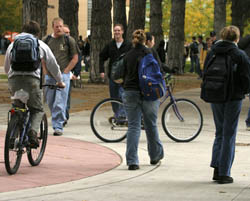
Some fear bikes on campus
If students are looking for a faster way to cover the stretch between Old Main and the Fine Arts Building this year, they should consider their choices carefully.
According to the university sidewalk policy, the use of any vehicle on walkways is prohibited. An increase in popularity of motorized scooters this year has caused worry that traffic of the scooters could increase on campus sidewalks as well.
However, students seem to be more concerned about bicycles on campus than motorized scooters.
“I hate bikes. You shouldn’t be allowed to ride bikes on campus,” history major Dave Rasmussen said.
The University Walkway Safety Policy was instated in 1997 with House Bill 196 at the Utah Legislature. The policy was created because “people should be able to walk on the campus without being threatened by wheeled vehicles.”
Vehicles is later defined as “any apparatus or equipment used to transport personnel and/or goods.”
The policy states, in Section 509.2, Part 2.2, “The operation of motorcycles or motorized scooters on any walkway is prohibited at all times.”
Rasmussen said he’s been “almost maimed” while walking to class when a biker talking on a cell phone came around a corner and lost control.
The first offense of this is a verbal warning by the USU Police – the second offense is a $25 fine and impounding of the vehicle. On the fourth offense, criminal charges can be filed.
The consequence for doing so is a traffic ticket and a fine that is decided in court, Lt. Shane Sessions, USU Police, said.
The policy is in effect at all university campuses in Utah; enforcement of the policy varies from school to school.
In reference to motorized scooters, University of Utah police dispatcher Jody Richins said, “We have people doing it, yes, but they’re not supposed to.”
Richins said action probably wouldn’t be taken unless it became a problem, but consequences for breaking policy rules would be the same as at Utah State University.
“The only things that are really allowed [on campus sidewalks] are pedestrians,” Sessions said about the policy at USU.
Police have yet to receive any complaints regarding motorized scooters on campus, he said.
Mechanical engineering major Jordan Sefcovic doesn’t think the motorized scooters are any more of a problem than bikers. Because of the bikers, Sefcovic said he is extra careful walking down Old Main Hill at night.
“It gets a little bit sketchy,” Sefcovic said, referring to bicycles careening down the hill too fast to notice pedestrians.
Other students have noticed the cyclists as a possible hazard.
“Yeah, I’ve almost been hit a couple of times,” Ben Kessen, a freshman majoring in physical therapy, said.
Nathan Smith, a graphic design major, doesn’t really have a problem with pedestrians while biking on campus.
“You can usually find ways around them,” he said.
Section 501.1 in the Walkway Safety Policy states, “Anyone using a bicycle, skateboard or in-line skates on USU property shall give right of way to any pedestrian and shall travel at a reasonable, safe and prudent speed.”
Bikers that swerve through and around pedestrians can make walking to class dangerous for anyone, Rasmussen said. He said it could get so bad that lanes on the sidewalk, one for bikes, and one for pedestrians, would have to be made.
Biker Curtis Reed, a freshman majoring in history and political science, uses his bike because “it’s faster and easier to get around.”
He said he takes care to watch for pedestrians when he is on the sidewalk.
“I just don’t go very fast,” he said.
Smith didn’t know about a specific walkway safety policy, but says that he has seen signs with rules on them. Smith said he has never worried about bike rules though because “they don’t enforce them.”
Smith rides his bike because he doesn’t have to deal with parking, he said.
Emily Buckley, a public relations major, has seen increases in the number of scooters used by students this year and wants to purchase one herself.
“Parking is so bad here, I think it’s great to have an alternative,” Buckley said.
-natandrews@cc.usu.edu