
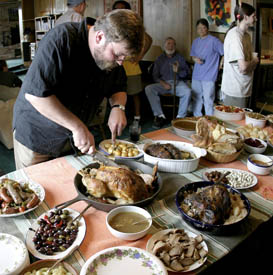
Dr. Jay serves it up
Jay Anderson could be considered the world’s expert on Thanksgiving.
“It’s unique,” Anderson, a history and folklore professor at Utah State University, said about Thanksgiving. “There’s no other country that really does a holiday quite like this.”
“Thanksgiving is a major American holiday,” he said. “We have this huge feast with the turkey and everything. We have a great time,” Anderson said.
Also known as “Dr. Jay”, Anderson presented an article called “Thanksgiving in the USA: The Meal as Medium and Message” to the International Ethnological Food Research Conference in Finland 30 years ago. Wednesday, Anderson will travel to Dubrovnik, Croatia where he will once again give a presentation on Thanksgiving to the 15th ICEFR conference.
The conference, which runs once every couple years, is put on by the International Commision for Ethnological Food Research. Its purpose is to investigate the role of food as a cultural indicator.
This year’s food conference theme is “Mediterranean food and its influences abroad.”
Anderson will return to talk on Thanksgiving, but his presentation will be different
Sticking to the theme, Anderson will show how four different Mediterranean-American families celebrate Thanksgiving.
The family’s native countries included Lebanon, Portugal, Italy and Greece.
In researching the subject, Anderson soon found his early assumptions were wrong.
“My first conception was that they would do the typical American Thanksgiving; turkey, stuffing, that kind of thing,” he said.
Although, many of the families cooked some traditional dishes, Anderson found, for the most part, their main dishes were different.
“It turned out they did 1,500 raviolies,” he said about the Italian-American family main Thanksgiving dish. A Greek roast leg of lamb, an incredible Portuguese rice dish with shrimp and bacon, pork loins with sauerkraut, he said were some of the other dishes made by these families.
“They all did whatever they were used to in their old country as their big Thanksgiving feast,” he said.
Anderson, in preparation for his trip to Croatia, decided to prepare the feasts himself for photo slides and experience to aid his presentation.
“Why not, before I go, just invite my friends and students and colleagues,” Anderson said about the feast.
He spent two days preparing the food and on Sept. 12, at his house, he celebrated a Mediterranean-American Thanksgiving feast amongst friends.
He filled a large dining table with about 20 dishes including the Greek roast lamb leg, Italian sausages, roast turkey, Greek stuffing, Portuguese sweetbread, pork with sauerkraut and more.
About 20 undergraduate and graduate students, professors and friends of Anderson attended the feast.
“It’s amazing that there’s somebody so dedicated to folklore and food ways, that they spend a whole day before a party getting the food ready and preparing the feast,” said Faye Mays, a liberal arts and science sophomore and a student of Anderson’s
“I thought it was a really good representation of a lot of different European and Mediterranean cultures,” Mays said. “It was quite delicious as well.”
“All of these dishes were traditional feast dishes and they all focus on meat. It shows you in many societies, meat was reserved for special occasions,” said English professor, Peter Mentzel about the feast.
“I feel like an engorged tick,” Mentzel said after eating.
“Food becomes a symbol of the culture and it’s infused in fascinating ways,” Anderson said.
-joelfeathers@cc.usu.edu