
Rocket launch excites middle-school students
Students from the North Cache 8/9 Center were able to experience the thrill of rocketry Friday afternoon thanks to a grant from the Experimental Sounding Rocket Association (ERSA) and the Rocky Mountain NASA Space Grant Consortium.
“It was way loud and it was dang cool too,” Chalese Buttars an eighth grader at North Cache 8/9 said.
With 200 pounds of thrust and after two attempts many, North Cache students watched as a powerful rocket fired across the school yard. Three firemen were on hand in case of fire hazards.
“Rockets are fun,” said Paul Mueller, the chief engineer of ERSA and a faculty member at Utah State University.
Katy Anderson, an eighth grader at North Cache said, “It was loud and I thought it was going to catch that tree on fire.”
Students at North Cache 8-9 have recently been working on bottle rockets with pop bottles and analyzing the data for their science class, Greg Nichols, a North Cache science teacher said, explaining the class has been learning about energy motion.
“It explains a lot more than just staying in the class room,” Alex Cespedes, an eighth grader said.
The outreach program is a non-profit organization to get school kids interested, Dushku said.
“It’s a good way to get kids motivated about science and math,” Mueller said.
Learning just how rockets actually work, using bottle rockets, and designing rockets that fly straight and high was what the class did, Nichols said.
“It’s a hands on project,” John Vanderford the outreach director for NASA Space Grant at Utah said. “To get young people a little more interested in science and so that they’ll find math less intimidating and they’ll stay in the science system.”
Nichols said such demonstrations are key to keeping kids interested and engaged.
“We’re losing in this country kind of a cutting edge,” Vanderford said, saying that often a lot of the technology that we inherit is going to other countries because of the lack of people who are looking for careers in science.
If students continue to lose interest in science for whatever reason, the United States will have less people to develop technology, Vanderford said.
“This is fun with science,” Mueller said, adding activities like this show applications of what they (students) are learning and what they can learn.
The project was made possible through the financial support of NASA, the USU engineering department and Walden Trailers, Mathew Dushku, an engineer from ERSA said.
It was about $16 for the experiments operational cost, Mueller said.
The rocket consisted of a hose and 40 gallons of water for emergencies, a bullet proof canopy, pure oxygen and synthetic rubber inside (donated by ATK Thiokol), Dushku said.
Mueller and Dushku designed the rocket for the students.
The next rocket test will be in Wendover, Nev., in March where four universities will be involved, Dushku said.
The launches for the school will conclude next Thursday with the launch of student-built rockets.
-amysueh@cc.usu.edu
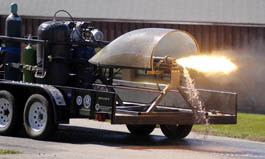
The Experimental Sounding Rocket Association (ERSA) demonstrates a trailer mounted rocket motor to students at the North Cache 8/9 Center. The rocket was fueled by oxygen and synthetic rubber and produced 200 pounds of thrust. The experiment was funded by several groups, including the Rocky Mountain NASA Space Grant Consortium. (Photo by Ryan Talbot)