
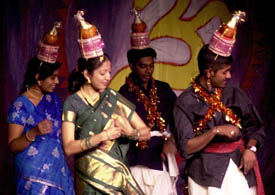
Diwali brings Indian tradition to a sold out-crowd
Cultural experience from a country with over 1 billion people, 300 known languages and 25 diverse states culminated Saturday night in what Logan Mayor Doug Thompson described as a thoroughly enchanting evening of music, dance and curry.
Also known as the Festival of Lights, Diwali is one of the most widely celebrated Indian festivals and the largest event held by the Utah State University Indian Student Association (ISA). The celebration brought together a conglomeration of about 500 people.
“People really like our Indian culture,” ISA president Charles Mellala said. “We always like to show the unity and diversity.”
Both foreign and American patrons of the event arrived in large numbers around 5:30 p.m. wearing everything from semi-formal suits and dresses to traditional Indian dhotis and sarees.
Beginning with an appetizer pastry filled with potatoes and peas, event-goers were then led into the TSC Ballroom after small red dots were placed on their foreheads.
“Most Indians wear a mark on their forehead between the two eyes known by various names, such as ajna, charka, the spiritual eye or the third eye,” said Ranjitha Dhanasekaran, a graduate student studying computer science. “It is said to be the major nerve center in the human body. According to ancient Hindu sages, [a mixture of] red lead powder (sindhoor) and sandal wood paste has cooling properties. Using these substances cools the nerve center associated with that location, and consequently the mind becomes calm and quite,”
After members of the audience found their assigned seats, master of ceremonies Paul Joseph and Nisha Champaneri began the program by introducing Thompson as the chief guest, who lit a lamp representing the triumph of light over evil and gave a small speech.
“We, as Americans, are true slackers,” Thompson said. “Our holidays last for one day. Diwali lasts for seven days.”
While explaining Diwali, Joseph said in India there are numerous festivals as diverse as the people who celebrate them.
“But when you talk about festivals, the first thing you talk about is Diwali,” Joseph said.
Thanking the audience for their attendance, Joseph went on to explain an experience where he found himself accidentally in the woman’s restroom. Because at that time there were no women coming or going, Joseph said he was in the wrong place at the right time.
“[Tonight] you are all in the right place at the right time. Nothing else better is going on in Logan now,” Joseph said.
The dances were filled with vibrant colors and fast paced movement to the beat of traditional and modern Indian music.
One folk dance from Garba, a western state, included nine dancers using sticks and dancing in a vortex of swirling colors.
One member of the association performed a solo dance with a mixture of western and Indian music styles. She wore traditional woman’s clothing in front but dressed as a man with a blue outfit and mask on the back of her head. Her choreography was a hit with the audience who loudly applauded their approval.
Shyam Kumar, the ISA cultural secretary, participated during many of the events, including a karaoke rendition of “Jaane Kyoon,” a song which asks why people fall in love when it’s such a bother.
Midway through the program, dinner was served to a very eager audience. The dinner included Indian flatbread, called na’an, plain rice, various types of curry and an indian drink called a mango lassi. Both the appetizer and dinner for the evening were catered by the Indian Oven, located inside the Sinclair station at the corner of 1000 N. 700 East.
The evening used a lot of slides to show pictures of the various provinces, musical instruments, dances and other cultural aspects of the country.
Joseph and Champaneri chatted back and forth sharing bits of cultural trivia, such as the state of Indian dentistry. Joseph said, that, as opposed to America where dentistry costs a lot of money, in India residents have their teeth cared for on the side of the street.
“[In India] it’s not OK to have bad teeth,” Joseph explained. “It’s affordable.”
Though they’ve held the Diwali celebration for several years now, many of the participants still don’t know why they celebrate it, Lisa John, co-director of the Ramayana tribute, said.
“Many of those who come still don’t know why we celebrate Diwali,” John said. “This is the reason we have [the Ramayana performance]. We want people to know why we celebrate Diwali.”
“Ramayana is one of the greatest epics in India,” Kumar said. “[It] has a king and a demon and the king fights the demon. It signifies victory of good over evil, and the king returns to his place victorious and the whole city is filled with lights and that’s why we have Diwali. That’s the significance of Diwali. We believe in [that story], it’s a reality. That’s the reason we have this event.”
Taking much of their inspiration from contemporary Bollywood movies, members of the ISA also performed dances and songs with fast-paced music. Bollywood is the moniker for the Indian film industry, located mainly in Bombay.
One event, directed by Amob Meno, contained a medley of three Bollywood songs performed by five couples.
“The first song is kind of a laid back song,” Meno said. “The second song, a party, marriage kind of song and the third song is about the success of love and how guys and girls don’t care what happens as long as love is involved.”
Josh Law, an undeclared freshman, attended Diwali for the first time Saturday and said he had an incredible time.
“I think the mixture of music, lights and just pure excitement was just marvelous,” Law said. “I loved to see the dancing and I really enjoyed the [informal dance] at the end because we were able to use what we’d just seen other people using and kind of experiment and have a good time. We had a great time implementing the techniques and the culture into our dance.”
Though he enjoyed the dinner, which included Na’an, rice and various kinds of curry, Law said he wouldn’t recommend eating a lot of curry before dancing.
“It’s not the best feeling in the world,” Law said.
For those who missed Saturday’s event, the tickets were sold out a week before the event. ISA will be sponsoring a similar event next spring to celebrate various festivals from all over India.
-mattgo@cc.usu.edu
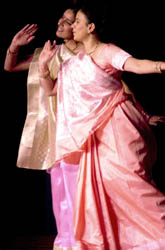
Two performers interact during a an Indian dance at the Diwali celebration in the TSC Ballroom. (Photo by Michael Sharp)