
Critters for Lunch
No one was eating at the college of Natural Resources Critters for Lunch activity Friday.
Despite the activity’s misleading title and close location to the Carousel food court, food was not even involved.
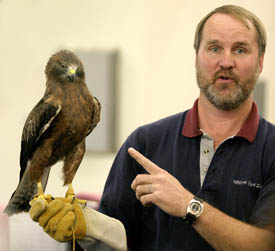
Utah State University students and parents with their small children gathered in the TSC International Lounge to watch as Willow Park zoo keeper, Dale Ashcroft, displayed some of the zoo’s animals as part of Natural Resources Week at USU.
Ashcroft started the hour-long presentation with a disclaimer saying, “Sometimes I’ll know the answer, but to be honest, sometimes I won’t know the answer. In case I sound like I know it all and I’ve done it all, that’s not true.”
Ashcroft then began by showing the crowd a white, Australian parrot. Toddlers giggled as the bird performed tricks on Ashcroft’s finger.
“I’d let you pet her, but sometimes I can’t tell who she likes and who she doesn’t like until it’s too late,” Ashcroft said.
The wings of permanent Willow Park birds are clipped, but the birds are still able to fly short distances.
“Clipping a bird’s wing is just like cutting your hair,” Ashcroft explained, much to the relief of the young children present.
Ashcroft said all zoos are required to meet certain standards in how their animals are treated and animals are provided with special diets and pure water.
“Don’t ask how that’s comparable to the wild,” Ashcroft said. “The purpose of zoos are not to change or replace the wild. The wild is better, but zoos have their place.”
Zoos aid in rehabilitating hurt animals and endangered species as well as providing educational opportunities for communities, he said.
To demonstrate this point, Ashcroft showed a screech owl that only had half of one of its wings. The owl was injured in the wild and is no longer able to survive there.
The last bird Aschcroft displayed was a Swainson’s hawk. The hawk wore a leather leash similar to that used by falconers.
“The leash gives a margin of safety, especially around small kids, since you never know what might happen,” Ashcroft explained.
During the winter, most of the birds are kept inside and shown to schools for educational purposes.
“The birds get excited to visit schools,” Ashcroft said. “When I bring out the traveling boxes they start bouncing up and down on their perches like they can’t wait to get in. The birds don’t mind being in cages, but they don’t seem to understand the concept of windows.”
As a grand finale, Ashcroft opened a canvas bag that had been lying on the table and pulled out a California king snake.
Although women are often associated with a fear of snakes, Jocelyn Parker, a senior majoring in liberal arts, fought the stereotype during the Critters for Lunch activity.
“Oh, she’s pretty,” Parker said as she looked at the snake.
Several observers backed away when Ashcroft offered to let someone hold the snake, but Parker immediately volunteered.
“It’s cool how he knots himself up,” Parker said as the snake coiled around her arm.
“It used to be that everyone would scream when I brought the snake out, but now there are only a few screamers. Most kids are excited,” Ashcroft said as he knelt on the ground so the little kids could feel the snake’s scales. “I was going to bring a Columbia Red Tail Boa, but he had just eaten and snakes are a little squeamish around people right after they’ve eaten.”
“To be honest, I hate snakes. They scare me,” Ryan Jensen, a senior majoring in broadcast journalism, said to a friend.
“Don’t squeeze him, he’s just looking for a dark quiet place to hide,” Ashcroft said as the snake attempted to crawl into a student’s jacket.
California kings are non-venomous and kill their prey with their teeth.
Typically, they like to eat other snakes. Animal handlers must be careful to keep the birds and snakes separate since they don’t really get along, Ashcroft said.
Willow Park Zoo is home to more than 100 species of birds, 12 mammals and various fish and turtles. The park is located at 419 W. 700 South in Logan. A 50-cent admission cost is advised for park upkeep.
-amcconkie@cc.usu.edu