
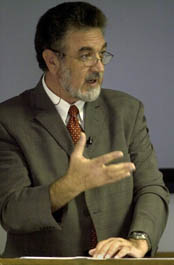
Israel professor lectures on science and religion
Professor Menachem Fisch from Tel Aviv University in Israel presented a talk entitled, “Science, Judaism, and the Religious Crisis of Modernity,” Tuesday to more than 100 students.
The presentation, sponsored by the departments of languages, philosophy and speech communication at Utah State University, was made possible by a grant from the John Templeton Foundation through the American Scientific Affiliation. The lecture addressed the issue of science and religion in Judaism.
Fisch is one of the leading scholars on science and Judaism in the world, according to USU faculty member Richard Sherlock. He is also an expert on 19th century British science and philosophy, Sherlock said.
Fisch, who has held positions at universities such as Cambridge, Oxford and Princeton, began his address by stating that science and religion have a long-standing tendency of conflict with one another. Fisch said this is due to two different schools of thought: rationalism and empiricism.
Fisch said historically, science and scientific evidence has had shaping power over the thoughts and actions of individuals within a society. He used the example of Descartes and his principles of rationalism, which were widely accepted at the time.
According to the Stanford Encyclopedia of Philosophy, the basis of Descartes theory of rationalism is “one of epistemic priority, referring to the matters one must first confront if one is to suceed in acquiring systematic and expansive knowledge.”
Fisch said Descartes’ principle methods – foundationalism and doubt – are integrated. He said because Descartes holds that matters that are prima facie obvious, or self-evident, often turn out false. Since the methods of foundationalism depends on the ability to avoid such errors when identifying the foundations, Fisch said, a complement method is required if the search for unshakeable foundations is to succeed.
Fisch offered background information on the religious history of the time, namely the Protestant reformation. He said two books were present: the book of words and the book of nature, and protestants at the time wished to dissolve symbolism and make the books more factual. He said this introduced a problem that is still in existence today: how to interpret Biblical law as it applies to the individual.
He described two groups of individuals and how they interpreted the books – those who interpreted the book dogmatically, or “by the letter of the law”, and those who were more pluralistic, who viewed everything as open to debate and relativism.
Fisch used the example of Judaism and the studying of the Torah. He said within the Torah everything is open to interpretation, and former beliefs are expected to be criticized, and continue to change as personal values and beliefs change.
Fisch said in many instances, humans err because they misinterpret a word as final and unchanging.
“In science and religion, people disagree not because of their findings, but how they interpret the findings,” Fisch said. “People become dogmatic toward those interpretations, believing that there is only the one way to do things, and that is simply untrue.”
Fisch said he cautioned students that, “When one hears something, even from a trustworthy individual, one should not submit and follow unless you receive evidence for yourself.” Fisch said he stresses the importance of individually evaluating the information presented, and from there combining the basis of religious and scientific findings in forming personal opinions.
Jordan Singleton, a senior who is working on a dual major in psychology and philosophy, said, “It seems like we need a solid foundation of laws and principles as a society, but that we also need open debate and criticism on what we discover about the world. Fisch offers a provocative answer to this dilemma.”
-amberem@cc.usu.edu