
Artist fuses worlds of words and art
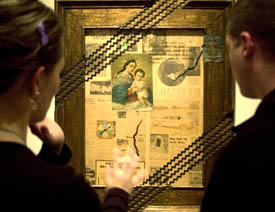
Visiting artist Alexis Smith uses magazine covers, newspapers and other memorabilia to create collages.
She has also designed works of art that cover walls, floors and landscapes of well-known institutions around the country.
Smith spoke at the Kent Concert Hall Friday morning about her creative projects and how she became interested in the visual arts.
“I didn’t start out as an artist. I didn’t have any idea what to be,” she said.
Smith attended the University of California where she earned her bachelor’s degree. At first she studied to be a French teacher, until she began taking art classes and realized what she could do with art.
Smith said she tries to use images that people don’t have to be an artist to understand, but can still make people think.
In her collages, Smith uses quotes from authors including Walt Whitman, Jack Kerouac, Raymond, Chandler, F. Scott Fitzgerald, Gertrude Stein, John Dos Passos and others.
Smith described a collage as “a real serendipitous choice for me.”
By incorporating words with her collages, it makes people think about her art and the meaning of the words, she said.
A quote by Einstein, “imagination is more important than knowledge” is featured in one of her collages.
Some of Smith’s collages use maps. Smith said “the romance of travel” is a common theme in her work.
Smith created a mural entitled “Same Old Paradise” that is displayed in the lobby of a museum in New York. It shows fields, oranges, mountains and a road that ends as a curled-up snake.
Smith also created a collage made up of billboard fragments within the mural. It is 10 feet wide, 66 feet long.
“If it looks good small, it’s really going to look good big,” Smith said of her art.
Many of her works include images of women, such as one collage entitled, “Men Seldom Make Passes at Girls Who Wear Glasses.” The vast collage is of Marilyn Monroe, and her glasses are uniquely shaped picture frames Smith found. In the picture frames are football players “making passes.”
She also has a collage called “Ring of Fire” with a basketball hoop and fire rising underneath it, with the words “A hellhole if there ever was one,” across the top.
Another one of Smith’s collages is a picture of space. She used hubcaps as spaceships.
“I work with a lot of different media,” Smith said.
Not only does Smith create collages, she has also designed art for museums, businesses and even a restaurant.
For San Diego State University, Smith designed a snake path to the library building. The snake appears to wrap around a sidewalk and then leads to the door. She found a shape to use that looked like a scale, and every piece was cut individually and put together. It measures 10 feet wide by 600 feet long.
Smith was asked to design the walls for a new restaurant with only a few months working time. The Getty Center restaurant in Los Angeles now has walls showing historical art that was inspired by Smith’s trip to Italy.
She also designed terrazzo floors for the Los Angeles Convention Center and for the new Schottenstein Center sports arena at Ohio State University.
For the L.A. Convention Center, Smith did a project using the night sky and the Milky Way for the floor design. The Scholttenstein Center floor shows basketball players drawn to a scale about the length of their heads, Smith said.
Doing commission projects such as these are a lot of work, Smith said. She tries to balance it with her collages.
“These things are fun for me,” Smith said, referring to all the things she uses in collage. “I’ve done a few sculptural installations.”
Smith has also collected children’s chairs for one display.
Smith’s work has been shown in museums in Los Angeles, New York and Boston. She encourages people to expand their art and be different.
Alexis Smith’s collage, “Holy Road,” will be on display in the Nora Eccles Harrison Museum of Art until May 1, 2005. “Holy Road” was inspired by a novel by Jack Kerouac.
Smith is just one of the visiting artists who have come to USU this year. Jay Heuman, education curator of the museum, said they have between one and four visiting artists a year. The Marie Eccles Caine Foundation supports the visiting artists.
The museum is open from 10:30 a.m. to 4:30 p.m. Tuesday, Thursday and Friday, from 10:30 a.m. to 8 p.m. Wednesday, from 12 to 5 p.m. on Saturday. The museum is closed Sunday and Monday.
-sdobson@cc.usu.edu