

Climate Change brings drought, rising temperatures and fire risk
Climate change affects the entire world, and Utah is no exception. Over the past four decades, Utah’s annual mean temperature has risen 0.4 degrees Fahrenheit every decade.
The rise in temperature has caused a multitude of changes in Utah’s climate and has created many problems because of it.
Scott Hotaling, assistant professor of watershed sciences at Utah State University, said the rise in temperatures has caused a decline in winter snowpack in Utah.
“The reservoir of snowpack each year in Utah is our seasonal buildup of water, and it is getting smaller,” Hotaling said. “It’s not getting smaller super fast, but it’s trending downward, and it has been for our 45-year record that we’ve been monitoring.”
Between 1979 and 2023, there has been a 16% decline in peak snowpack statewide.
Hotaling said along with the snowpack getting smaller, peak snowpack and runoff time are shifting further away from the summer months.
“It’s not a huge shift in timing, but it’s on an order of days, and every day that it shifts earlier means that there’s a longer summer dry period,” Hotaling said. “In Utah, we really need water in July, August and September. Those are the hottest and driest months of the year in Utah, so the more we shift our snowpack peak away from those months, the less water is actually going to still be available when those months come.”
Andre Geraldo de Lima Moraes, assistant professor of climate data analysis at USU, said another issue related to rising temperatures in Utah is a change in how much precipitation falls as snow in the winter.
“Part of the reason Utah has less snowpack is because it’s warmer during the winter, and precipitation that used to fall as snow is now falling as rain,” Moraes said.
Between 1960 and 2010, the proportion of winter precipitation falling as snow in Utah has declined by about 9%.
According to Brad Washa, USU assistant professor of wildland fire science, the change in snowpack and subsequent hotter, drier summers has increased fire risk in Utah.
”The snowpack is melting off pretty fast instead of building right now,” Washa said. “With the snowpack gone a lot earlier, fuels like grass and such that carry fire across the landscape are now available and have a longer period where they can dry out.”
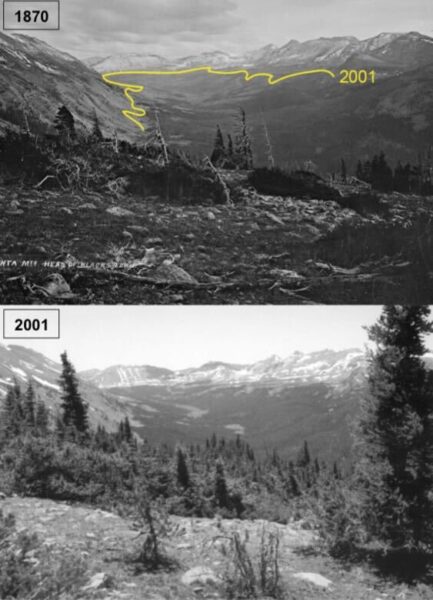 Submitted by Scott Hotaling
 Washa also said the timeframe for increased fire risk in Utah is getting longer.
”The fire season starts earlier in the summer and lasts later into the fall,” Washa said. “Last fall on the Wasatch Cache Uinta, there was the Yellow Lake Fire that lasted well into October — a fire of that size occurring in October is unheard of. Normally at that time of year, you’d start seeing cooler temperatures and more moisture.”
Washa said as temperatures continue to rise during the summer, the fires are going to start burning at a higher level of severity.
According to Moraes, hotter summers in Utah also lead to issues with crops in the summer.
“Hotter summers also mean more rapid evaporation from the crops, which means farmers have to use more water,” Moraes said.
Wei Zhang, assistant professor of climate science at USU, said the public should also be concerned because it impacts everyone who lives in Utah.
“I think everyone should definitely be aware of climate change for many reasons. There’s the changing water cycle, for example, that increases drought occurrence — drought intensity — in Utah,” Zhang said. “Those effects on the water is a big deal in Utah because we are in the dry region, so if the water gets more and more diminished, then that’s going to affect everyone here.”
Hotaling said in order to help fight climate change, the public should work to educate themselves, specifically on what choices are the most impactful in terms of urban emissions and greenhouse gases.
“Practicing using public transport or riding a bike or walking to work when you can really helps. Using solar power is also more efficient and climate-friendly than burning coal or natural gas,” Hotaling said. “Meat just as a product of how it has to be raised and the amount of resources that go into it can be a very climate-intensive thing to produce. So, if you want to eat meat, at least try and make better choices like chicken or pork or beef — also eating more vegetables. Instead of drinking regular milk, drink alternative milk, which uses way less water. It’s really about personal choices and being more mindful of those.”
For students who want to get involved with climate change, USU offers a Climate Adaptation Intern Program.
Those who wish to find more information about climate change can visit the USU Climate Adaptation and Resiliency page.