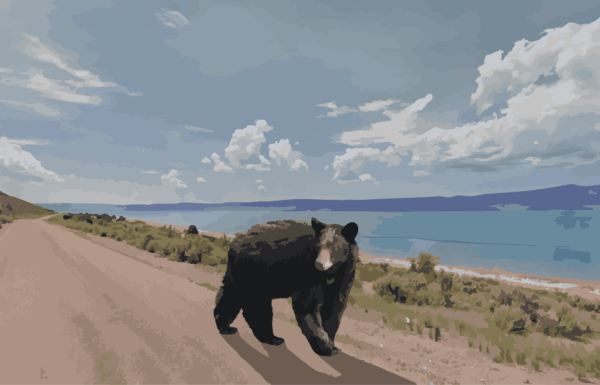
Black bear killed by vehicle at Bear Lake
Bear Lake State Park announced via their Facebook page the death of a black bear at Bear Lake this week.
“We’re saddened to share that a black bear was struck and killed by a vehicle on the east side of Bear Lake near Cisco Beach on the Utah side,” the post said.
According to Utah Division of Wildlife Resources wildlife biologist Sam Robertson, animal-vehicle collisions are common in rural areas like Logan Canyon and areas surrounding Bear Lake.
“2024 — through November, we had about 8,000 reported wildlife-vehicle collisions,” Robertson said. “Only half of actual collisions get reported, so it was probably closer during and all around 15,000-16,000, and that’s held steady for the last few years.”
Robertson said there were an estimated 4,000 black bears in the state in 2021, inhabiting the state’s high-elevation forests.
“We have had more sightings in northern Utah around Cache Valley and Logan Canyon the last couple of years,” Robertson said. “It does seem like our bear population here is growing.”
Historically, black bears existed in high numbers in northern Utah but were nearly wiped out in the late 1800s and early 1900s due to hunting and habitat loss.
“Black bear numbers [in northern Utah] had been reduced quite dramatically relative to what they are now because of conflicts with livestock,” said David Stoner, research assistant professor for Utah State University’s Department of Wildland Resources. “At the time the pioneers showed up, we had mountain lions, wolves, black bears and grizzly bears in Utah to some degree.”
Black bears are a protected species in Utah. According to Stoner, they play key roles in the health of these ecosystems.
“What people have found with bears is that they can be important in terms of seed dispersal for certain plants because their digestive system does not masticate a lot of those seeds,” Stoner said. “They move plants around. They will then turn over a lot of dead wood.”
According to Robertson, the bear in question was likely a young male dispersing from Idaho to explore new territory.
“I’m assuming he was probably coming out for spring out of the dead time, maybe got pushed out of his territory by a bigger male or something — probably on the move looking for a new home,” Robertson said. “Just bad timing.”
The DWR manages Utah’s black bear population through research, hunting regulations and public education. According to Roberston, annual permits for bear hunting are issued based on population data, and biologists monitor bear activity to ensure stable numbers.
As Utah’s population grows and outdoor recreation increases, interactions between humans and wildlife have also become more frequent and more complicated.
“If numbers get high enough, we tend to see more conflict, and conflict can take the form of predators eating livestock — predators eating pet animals and on rare occasions, even attacking people,” Stoner said.
Robertson said conflict is exacerbated by lack of human vigilance.
“We’re starting to see that more and more people kind of ignore safety tips — keeping their camps clean, keeping food put away and just being aware that we do have bears,” Robertson said.
Some areas of the Wasatch Range now border neighborhoods and highways, placing wild animals in increasingly precarious positions. Wildlife crossings, underpasses and fencing have been effective in some regions, but these solutions are still limited in scope and funding. For now, education and awareness remain the most immediate tools.
“Most of the vehicle collisions with wildlife happen in the early hours or late — dusk and dawn,” Roberton said. “I just stress that people be careful when they’re on highways and be vigilant in their surroundings — if you know you’re in an area with wildlife, it’s always a good idea to slow down.”
Stoner said although the bear’s death is a tragedy, it’s also hopefully a good sign.
“The silver lining is that bears were eliminated a long time ago, and there are indications that black bears are starting to come back,” Stoner said. “I’ve personally found some sign in the canyon very intermittently — they’re there, and the fact that one turns up in Bear Lake is indicative that perhaps they are starting to recolonize areas where they have been absent for a long time.”
Bear Lake State Park echoed that sentiment.
“Seeing one return to the area is a rare and powerful reminder of the wild beauty that once thrived here,” the post said. “Let’s honor the memory of this bear by keeping our eyes open, slowing down, and respecting the land we share with the wild.”