

Utah State Club Tennis serves up competition and community
The Utah State University Tennis Club has grown from a casual recreation group into a competitive and tight-knit program thanks to the efforts of its student leaders and the dedication of its members.
Led by co-presidents Elle Falslev and Joseph Murray, the team balances travel, practices, fundraising and community involvement while creating opportunities for both experienced and beginner players to stay connected to the sport.
“We’re co-presidents, so we kind of oversee everything,” Falslev said. “We organize the other officers and make sure everything gets done, and we take care of all the travel things: booking the Airbnbs and the rental cars and registering for tournaments and making sure that we’re having competitive opportunities. We also plan all of the practices and feed the balls and run the tryouts — just form the teams.”
Murray explained the leadership team works on both competitive and recreational sides of the club.
“We manage the other captains. We’re responsible for putting on practices for our competitive and non-competitive teams. We run multiple events throughout the year, and we’re responsible for helping plan and be overall the traveling and competitive teams,” he said.
The club operates under Utah State’s Campus Recreation program but is entirely student-run. Officers handle fundraising, event planning, uniforms and social media while also ensuring tournaments and practices run smoothly. The work is extensive, particularly when it comes to travel.
“It’s a lot of work,” Falslev said. “We volunteer at all of the campus events — so basketball games and football games — and we’ll get paid for however many members and however long we’re there for. That’s where a lot of our funds come from, but we’ll also do a few fundraising events like mixed doubles tournaments, where people pay for registration, or just little things like that.”
Once the funding is in place, logistics become the next hurdle.
“Finding the Airbnbs and the rental cars and registering and making sure that we have teams to get there and uniforms and then getting there is a lot of work,” Falslev said. “We just work on that for — it usually takes a month to plan a tournament in advance, so we have to think about them all at the beginning of the season.”
Falslev and Murray have long histories in the sport, both being first introduced to tennis by their mothers. Falslev started playing at age nine, training at ACE Athletics Tennis Academy in Farmington and competing in tournaments across the region. By high school, tennis became her main sport.
“I started coaching when I was 16, and I’ve just kept playing and coaching ever since,” she said.
When she arrived at Utah State, she initially wasn’t sure if she wanted to continue competing.
“But one of my friends convinced me to try out with her, and after we went to the first tournament in Arizona, it was like the funnest weekend of our whole life,” Falslev said. “We got really close with the whole team, and I was just super excited about it ever since then.”
Murray picked up tennis at age five but said he didn’t take it seriously until junior high.
“My freshman year, I made the bottom varsity spot up in Idaho. I barely made the varsity team, and I was really excited. I played third singles and second mixed doubles my freshman year, and then I played first singles my remaining high school years,” he said.
He joined Utah State’s club in 2021, when it was still largely recreational.
“At that time, it was pretty much just a rec club where we just had tons of people come, and it was just an opportunity to come play [and] learn, and we didn’t really compete much that year,” Murray said. “We went and just played an invitational down in Salt Lake with a couple other schools, and that was it.”
The club began shifting toward more competition around that time, under the leadership of former captains Parker Achenbach and Chris Harker.
“They put in so much work, and they made the team so competitive that year,” Falslev said. “They set it up so well for us, and now we can just keep growing every year.”
That growth has taken Utah State players to tournaments across the Mountain West and beyond. The team regularly faces Colorado State University, Colorado School of Mines, Air Force Academy, Weber State University, Brigham Young University, the University of Utah and Boise State University.
The team has also faced the University of Nevada, Las Vegas and programs from Montana. At larger national tournaments, USU has even competed against schools such as Stanford, Yale, Minnesota State University, University of Wisconsin and the University of Texas.
“Our section is really growing, and it’s great to see this program grow because it’s so amazing that it allows so many people to play this competitive tennis without having to play for a college directly,” Murray said.
Competitions use the World TeamTennis format, where total games won across singles, doubles and mixed doubles determine the match outcome.
“Mixed doubles can win their set and then continue to win games until they win,” Falslev explained. “So, if you have a really good mixed doubles team, then you can come back from any score. We’ve had some really close matches where we’ll be down a lot of games and then win our set and then continue to win games and come back and win it for the match.”
Team chemistry plays a big role in doubles pairings and the energy of the format.
“The really fun thing about this format is there are substitutions, which is not in any other version of tennis,” Murray said. “So, let’s just say we’re playing mixed doubles and I’m not really feeling well. I can just sub myself out. We can send someone else in.”
The structure makes for high-energy environments where teammates crowd the court to cheer one another on.
“A lot of the time, tennis is seen as an individual sport where you’re not really cheering, but in our format, we’re on the court cheering for our teammates. Everybody’s supporting each other,” Falslev said.
Beyond competition, the club emphasizes community. Long road trips and tournament weekends forge strong friendships.
“Sometimes you’re driving and you’re stuck in a car together for 26 hours and you really get to know each other,” Murray said.
“Stay in the same house for two more days, and then you drive another 26 hours home, so we spend a lot of time together,” Falslev added.
That bond extends well beyond the tennis court. Members have attended each other’s weddings, celebrated together and built connections across many backgrounds.
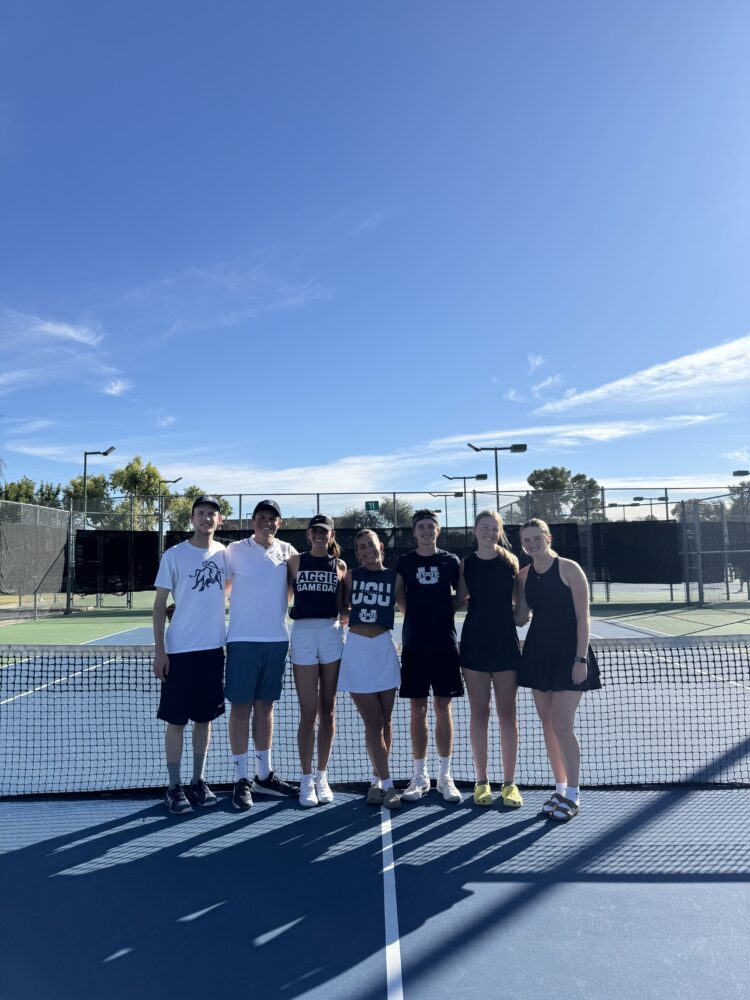
The Utah State Tennis Club team poses for a photo
The club also connects with the broader Utah State community through volunteer work at the various sports events, where members help with tickets, parking and other logistics. They also host an annual mixed doubles tournament open to the public, drawing in high school players, parents or whoever else wants to play.
Recruiting new members remains a priority each fall, particularly through events like Day on the Quad and Aggie RecFest. The team holds open hits during the first month of school, followed by tryouts in September.
“We love everyone to come,” Murray said. “We have people that have barely learned how to play tennis and just kept learning and growing, and they’ve become phenomenal players. On the competitive side, it is very competitive, but if you’re just looking to meet friends and learn, we have a place for you.”
The team typically travels two to three times per semester, totaling around five tournaments each year along with sectionals. Their long-term goal is to qualify for nationals.
“We haven’t yet, but we’ve gotten close,” Falslev said. “So hopefully this year, we’ll make it to the national tournament.”
For both presidents, tennis will remain part of their lives after graduation. They both work at the Sports Academy & Raquet Club. Murray also coaches at Ridgeline High Schol, while Falslev is pursuing a master’s degree in sports management.
“Now my goal is to become a tennis director at a big club somewhere or maybe at Sports Academy eventually,” Falslev said.
At its core, though, the club is about the relationships built through the game.
“The best way to find your friends here on campus is to get involved,” Murray said. “These are going to be the people you become friends with for life. Without this club, I would be a lot lonelier of a person.”